Corn Seed / Caryopsis Under the Microscope
Corn Seed / Caryopsis (Longitudinal Section), Zea mays
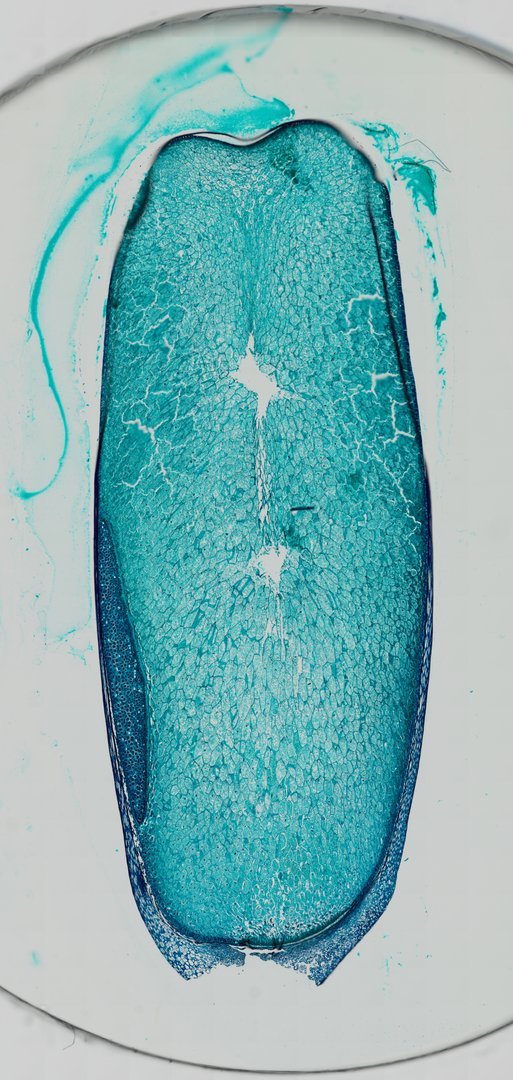
This is a lengthwise slice through a corn kernel stained with fast green. It shows the parts of a monocot seed, including the stored food and the tiny embryo plant.
A longitudinal section of a corn kernel or caryopsis (Zea Seed L.S.) stained with Fast Green, illustrating the anatomical architecture of a monocotyledonous grain. The outer boundary consists of the fused pericarp and seed coat (testa), enclosing a large endosperm region rich in stored starch and nutrient reserves bounded externally by an aleurone layer. Positioned along one side of the base is the monocot embryo, showing key functional structures including the shield-like scutellum (modified single cotyledon), the plumule protected by a sheath-like coleoptile, and the radicle enclosed by the protective coleorhiza.
What to look for
- Pericarp and seed coat: A thin outer layer wrapping the whole kernel.
- Endosperm: The large region filling most of the kernel, packed with stored starch.
- Aleurone layer: A single row of cells just inside the outer layer, at the edge of the endosperm.
- Scutellum: A shield-shaped structure (the single seed leaf) pressed against the endosperm.
- Coleoptile and plumule: The young shoot, wrapped in a protective sheath, pointing toward the top of the kernel.
- Radicle and coleorhiza: The young root, covered by its own sheath, pointing toward the base.
At each magnification
Low power (about 4x)
The kernel shape with a large endosperm and a smaller embryo along one side near the base.
Medium power (about 10x)
The scutellum, shoot, and root regions of the embryo.
High power (about 40x)
Aleurone cells at the edge of the endosperm and small, densely packed embryo cells.
Questions and answers
What are the parts of a corn seed under a microscope?
A corn kernel has an outer pericarp and seed coat, a large starchy endosperm, and an embryo. The embryo includes the scutellum (seed leaf), a young shoot inside a sheath called the coleoptile, and a young root inside a sheath called the coleorhiza.
How is a corn seed different from a bean seed?
Corn is a monocot, so its embryo has one seed leaf (the scutellum) and most of its food is stored in the endosperm. A bean is a dicot, with two large seed leaves (cotyledons) that hold most of the stored food.
- Category
- Botany & Plants
- Scan magnification
- 20x
- Stain
- Fast Green
- Tags
- corn seed longitudinal section, Zea seed L.S., Zea mays, corn kernel, caryopsis, monocot seed
Viewing this slide in class
This is a scan of a real prepared slide, not a simulation or a drawing. On StudyScope you can pan from the whole slide down to individual structures, always in focus, and measure them in real micrometers with the calibrated ruler. Present it live and every student screen follows your view and annotations. Students join with a room code on Chromebooks, iPads, or any browser, with no accounts.