Corn Stem Cross Section Under the Microscope
Corn Stem (Cross Section), Zea mays
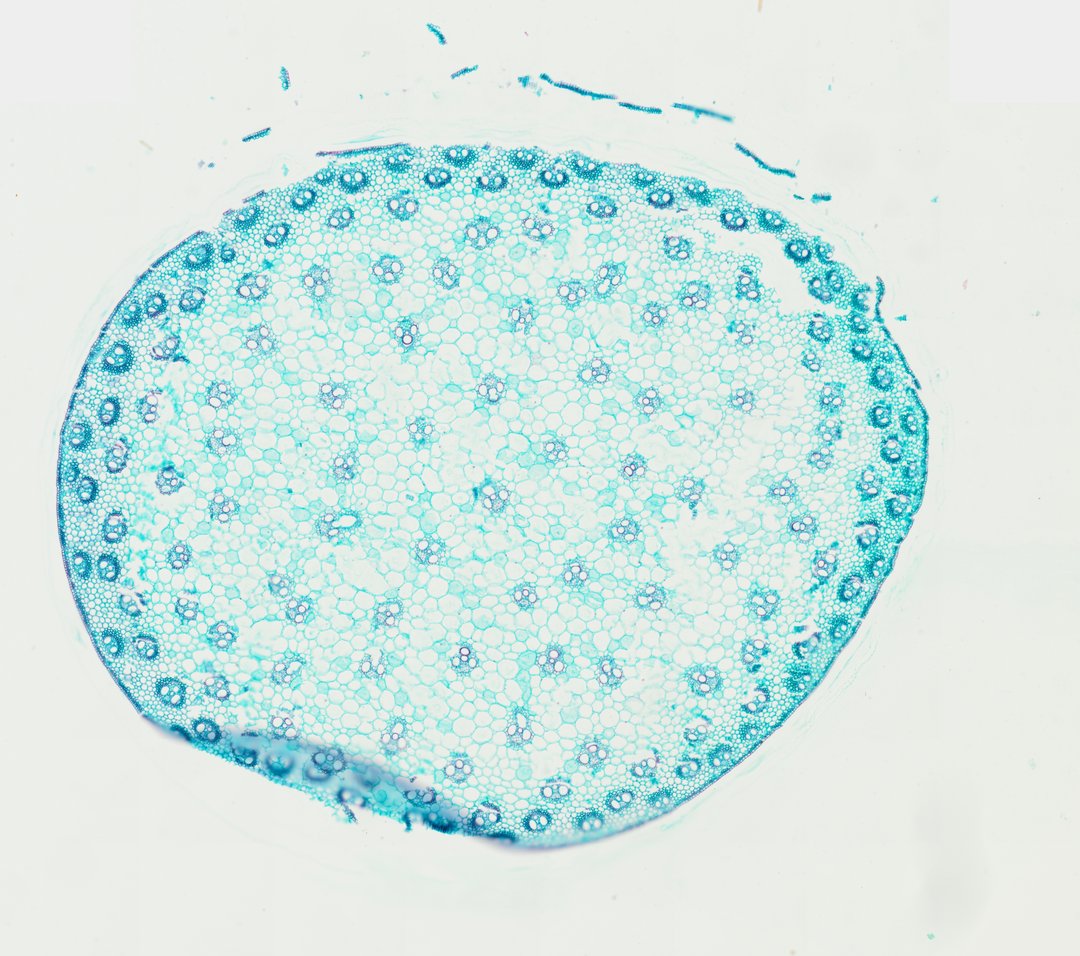
This is a cross section of a corn stem stained with fast green. It is the standard example of a monocot stem, where vascular bundles are scattered instead of arranged in a ring.
A cross section of a corn stem (Zea mays stem c.s.) stained with Fast Green, demonstrating the classic vascular distribution characteristic of a monocotyledonous stem. Numerous closed collateral vascular bundles are scattered at random throughout the extensive parenchymatous ground tissue, with a higher density concentrated toward the periphery beneath the outer epidermis. Each individual vascular bundle forms a distinctive face-like arrangement composed of large metaxylem vessels, protoxylem, and an outer cluster of phloem sieve tube elements and companion cells, all enclosed within a protective sclerenchymatous bundle sheath.
What to look for
- Epidermis: A thin outer layer of small cells around the edge of the section.
- Scattered vascular bundles: Many small oval bundles spread through the stem, more crowded near the outer edge.
- Ground tissue: Large, thin-walled parenchyma cells filling the space between bundles.
- Xylem vessels: Two large, open vessels in each bundle, often with a smaller one between them, together looking a bit like a face.
- Phloem: A cluster of small cells on the outer side of each bundle.
- Bundle sheath: A ring of thick-walled cells surrounding each bundle.
At each magnification
Low power (about 4x)
A round section dotted with many small bundles scattered throughout.
Medium power (about 10x)
Individual bundles with their surrounding sheath and large xylem vessels.
High power (about 40x)
The small phloem cells and the thick walls of the bundle sheath.
Questions and answers
What does a monocot stem look like under a microscope?
In a monocot stem like corn, the vascular bundles are scattered all through the stem instead of forming one ring. There is no clear division into cortex and pith, and each bundle is wrapped in a sheath of thick-walled cells.
What is the difference between monocot and dicot stems?
Monocot stems have scattered vascular bundles and no ring of cambium, so they generally do not grow wider with wood. Dicot stems have bundles arranged in a ring, with pith in the center and cortex outside.
Why do corn vascular bundles look like a face?
Each bundle has two large xylem vessels that look like eyes, with smaller xylem cells and an air space below them and the phloem on the outer side. Students often describe it as a monkey face or skull, which makes it easy to recognize.
- Category
- Botany & Plants
- Scan magnification
- 20x
- Stain
- Fast Green
- Tags
- corn stem, Zea mays, corn stem cross section, monocot stem, scattered vascular bundles, atactostele
Viewing this slide in class
This is a scan of a real prepared slide, not a simulation or a drawing. On StudyScope you can pan from the whole slide down to individual structures, always in focus, and measure them in real micrometers with the calibrated ruler. Present it live and every student screen follows your view and annotations. Students join with a room code on Chromebooks, iPads, or any browser, with no accounts.