Nostoc commune Under the Microscope
Nostoc commune (Whole Mount) , Nostoc commune
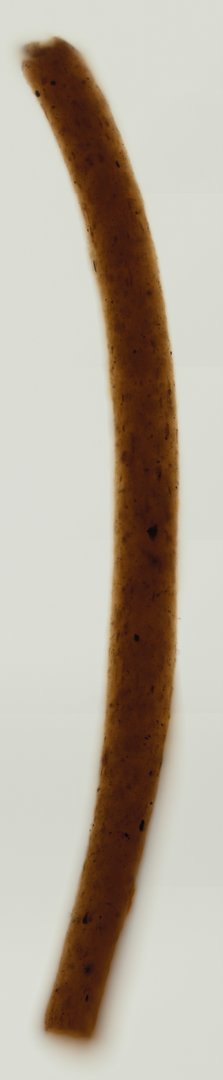
This slide shows Nostoc, a colony-forming cyanobacterium. Its bead-like chains of cells include special cells that capture nitrogen from the air, which makes it a great example of how bacteria can help feed ecosystems.
Nostoc commune is a colonial terrestrial cyanobacterium capable of surviving extreme environmental conditions through desiccation tolerance and nitrogen fixation. Under light microscopy, a whole mount specimen reveals an extensive extracellular gelatinous matrix composed of complex mucopolysaccharides that enclose entangled uniseriate filaments, or trichomes. Individual vegetative cells within the trichomes are spherical to barrel-shaped, arranged in characteristic bead-like chains or filaments. Specialized enlarged, thick-walled cells known as heterocysts are differentiated at intervals along the trichomes, providing an anoxic microenvironment essential for the activity of the nitrogenase enzyme complex responsible for atmospheric nitrogen fixation. Additionally, thick-walled resting cells called akinetes may form to ensure survival during prolonged desiccation. The brownish-gelatinous macroscopic structure protects the embedded bacterial colonies from mechanical stress, solar radiation, and dehydration.
What to look for
- Filaments (trichomes): Chains of round to barrel-shaped cells, like strings of beads, often tangled together.
- Vegetative cells: The ordinary cells that make up most of each chain.
- Heterocysts: Slightly larger cells with thicker walls, spaced along the chains, where nitrogen is captured.
- Gelatinous matrix: A jelly-like material surrounding the filaments and holding the colony together.
- Akinetes: Larger, thick-walled resting cells that may be present.
At each magnification
Low power (about 4x)
Clumps of jelly-like colonies.
Medium power (about 10x)
Tangled chains of cells inside the jelly.
High power (about 40x)
Individual bead-like cells and the larger heterocysts along each chain.
Questions and answers
What does Nostoc look like under a microscope?
Nostoc looks like tangled strings of beads inside a clear jelly. Each bead is a cell, and every so often a slightly larger, thicker-walled cell called a heterocyst appears in the chain.
What are heterocysts?
Heterocysts are special cells in some cyanobacteria that take nitrogen gas from the air and turn it into a form living things can use. They keep oxygen out, because oxygen would stop that process.
Is Nostoc an alga?
Nostoc is a cyanobacterium, which is a type of bacterium. It photosynthesizes like algae and was once called blue-green algae, but its cells have no nucleus.
- Category
- Microbiology
- Scan magnification
- 20x
- Tags
- Nostoc commune, cyanobacteria, Nostoc filament, heterocyst, gelatinous sheath, nitrogen fixation
Viewing this slide in class
This is a scan of a real prepared slide, not a simulation or a drawing. On StudyScope you can pan from the whole slide down to individual structures, always in focus, and measure them in real micrometers with the calibrated ruler. Present it live and every student screen follows your view and annotations. Students join with a room code on Chromebooks, iPads, or any browser, with no accounts.