Paramecium Under the Microscope
Paramecium (Whole Mount), Paramecium
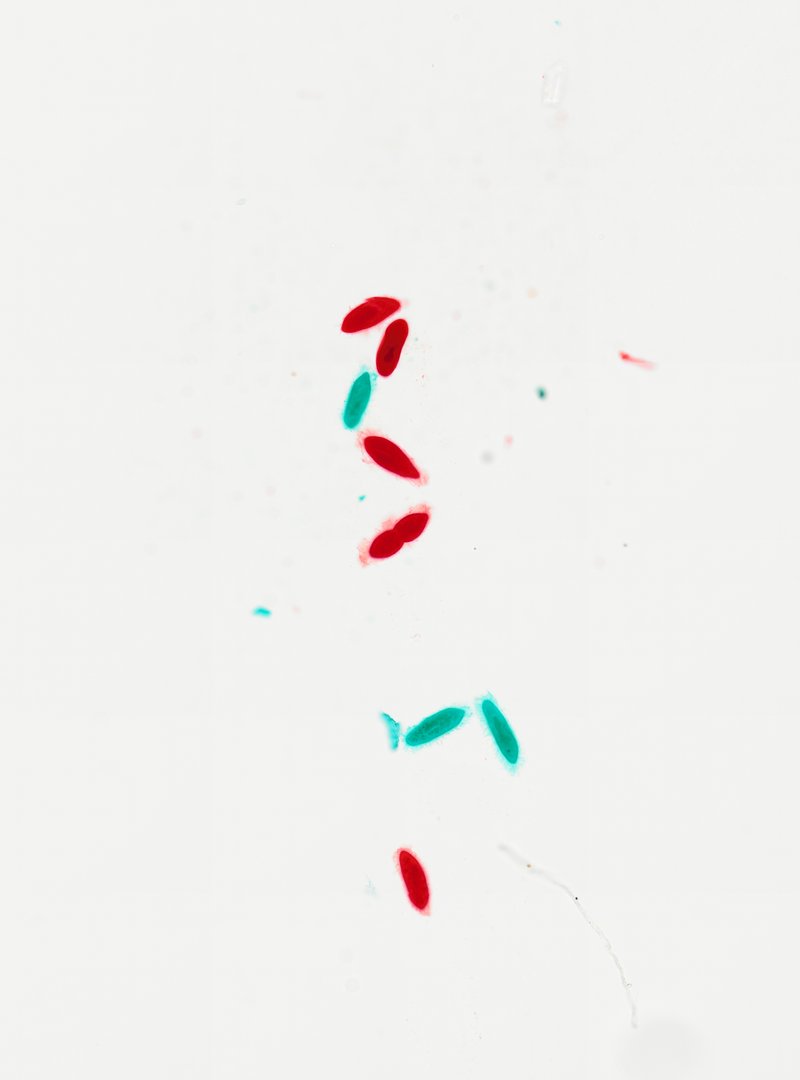
This slide shows many Paramecium cells mounted whole and stained. Paramecium is a single-celled organism covered in cilia and is one of the most familiar protists in biology class.
A whole mount preparation displaying individual Paramecium specimens, featuring their characteristic slipper-shaped unicellular morphology. The differential staining highlights single-celled ciliate protozoans with distinct red and teal cytoplasmic coloration, allowing observation of cell contours, rounded posterior ends, and tapered anterior profiles typical of these freshwater organisms.
What to look for
- Slipper shape: An oval cell with one end more rounded and the other more tapered.
- Oral groove: A dent along one side of the cell where food is swept in.
- Macronucleus: A large, dark-staining nucleus near the middle of the cell.
- Micronucleus: A much smaller nucleus next to the macronucleus, which can be hard to see.
- Food vacuoles: Small round bubbles inside the cell holding food being digested.
- Cilia: Very fine hairs covering the surface, often hard to see on stained slides.
At each magnification
Low power (about 4x)
Many small oval cells scattered across the slide.
Medium power (about 10x)
The slipper shape and the dent of the oral groove.
High power (about 40x)
The macronucleus and food vacuoles inside the cell.
Questions and answers
What are the parts of a Paramecium?
A Paramecium has cilia covering its surface, an oral groove for taking in food, food vacuoles, contractile vacuoles that pump out extra water, and two kinds of nuclei: a large macronucleus and a small micronucleus.
How big is a Paramecium?
Many common Paramecium species are around 0.2 millimeters long, so they are just barely visible to the naked eye as tiny specks in pond water.
How does a Paramecium move?
Paramecium swims by beating thousands of tiny cilia in waves. The cilia also sweep food into the oral groove.
- Category
- Microbiology
- Scan magnification
- 20x
- Tags
- Paramecium, Paramecium whole mount, Ciliate, Ciliophora, Unicellular organism, Slipper-shaped cell
Viewing this slide in class
This is a scan of a real prepared slide, not a simulation or a drawing. On StudyScope you can pan from the whole slide down to individual structures, always in focus, and measure them in real micrometers with the calibrated ruler. Present it live and every student screen follows your view and annotations. Students join with a room code on Chromebooks, iPads, or any browser, with no accounts.