Pittosporum tobira Leaf Under the Microscope
Pittosporum tobira Leaf (Cross Section), Pittosporum tobira
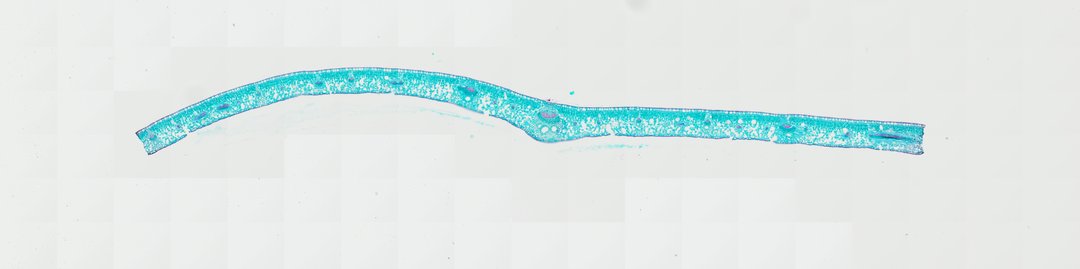
This is a cross section of a Japanese cheesewood (Pittosporum) leaf stained with safranin and fast green. It is a thick, leathery evergreen leaf with features that reduce water loss.
A cross section of a Japanese cheesewood leaf (Pittosporum tobira C.S.) double-stained with Safranin and Fast Green, highlighting xeromorphic structural modifications characteristic of leathery evergreen broadleaf foliage. A thick, protective waxy cuticle coats a well-developed, multiple-layered adaxial epidermis, minimizing transpiration loss. Beneath the upper hypodermis, densely packed columns of palisade mesophyll cells rich in chloroplasts form a multi-layered palisade zone above an extensive, loosely arranged spongy mesophyll layer traversed by intercellular air spaces. Prominent secretory canals (resin ducts) lined by epithelial cells are embedded within the mesophyll adjacent to vascular bundles. The midrib encloses a central collateral vascular bundle containing lignified xylem elements facing the adaxial surface and phloem tissue facing the abaxial side, braced by supporting parenchymatous and collenchymatous tissues.
What to look for
- Thick cuticle: A heavy waxy layer over the upper epidermis.
- Upper epidermis: The outer layer of cells on top of the leaf.
- Palisade mesophyll: More than one row of tall, tightly packed cells under the upper surface.
- Spongy mesophyll: Loosely arranged cells with air spaces toward the lower surface.
- Secretory canals: Small round canals lined with cells, near the veins.
- Midrib: The central vein, with red-stained xylem facing up and phloem below it.
At each magnification
Low power (about 4x)
A thick leaf blade with a large midrib.
Medium power (about 10x)
The layers of palisade cells and the spongy layer below.
High power (about 40x)
The thick cuticle and the cells lining the secretory canals.
Questions and answers
Why do some evergreen leaves have more than one palisade layer?
Leaves that grow in bright sun or stay on the plant all year are often thicker, with several rows of palisade cells. More palisade cells means more chloroplasts to capture light.
What makes a leaf leathery?
Leathery leaves have a thick waxy cuticle, sturdy epidermis, and thick layers of tissue inside. These features help them resist damage and hold on to water.
- Category
- Botany & Plants
- Scan magnification
- 20x
- Stain
- Safranin / Fast Green
- Tags
- Pittosporum tobira leaf cross section, Pittosporum tobira, Japanese cheesewood, pittosporum leaf, leaf cross section, xeromorphic leaf
Viewing this slide in class
This is a scan of a real prepared slide, not a simulation or a drawing. On StudyScope you can pan from the whole slide down to individual structures, always in focus, and measure them in real micrometers with the calibrated ruler. Present it live and every student screen follows your view and annotations. Students join with a room code on Chromebooks, iPads, or any browser, with no accounts.