Short answer: Look at the vascular bundles. In a monocot stem such as corn, the bundles are scattered all through the stem, with no clear cortex or pith. In a dicot stem such as sunflower, the bundles form a single ring, with cortex outside the ring and a large pith inside it. You can see the difference at the lowest zoom, before you look at a single cell.
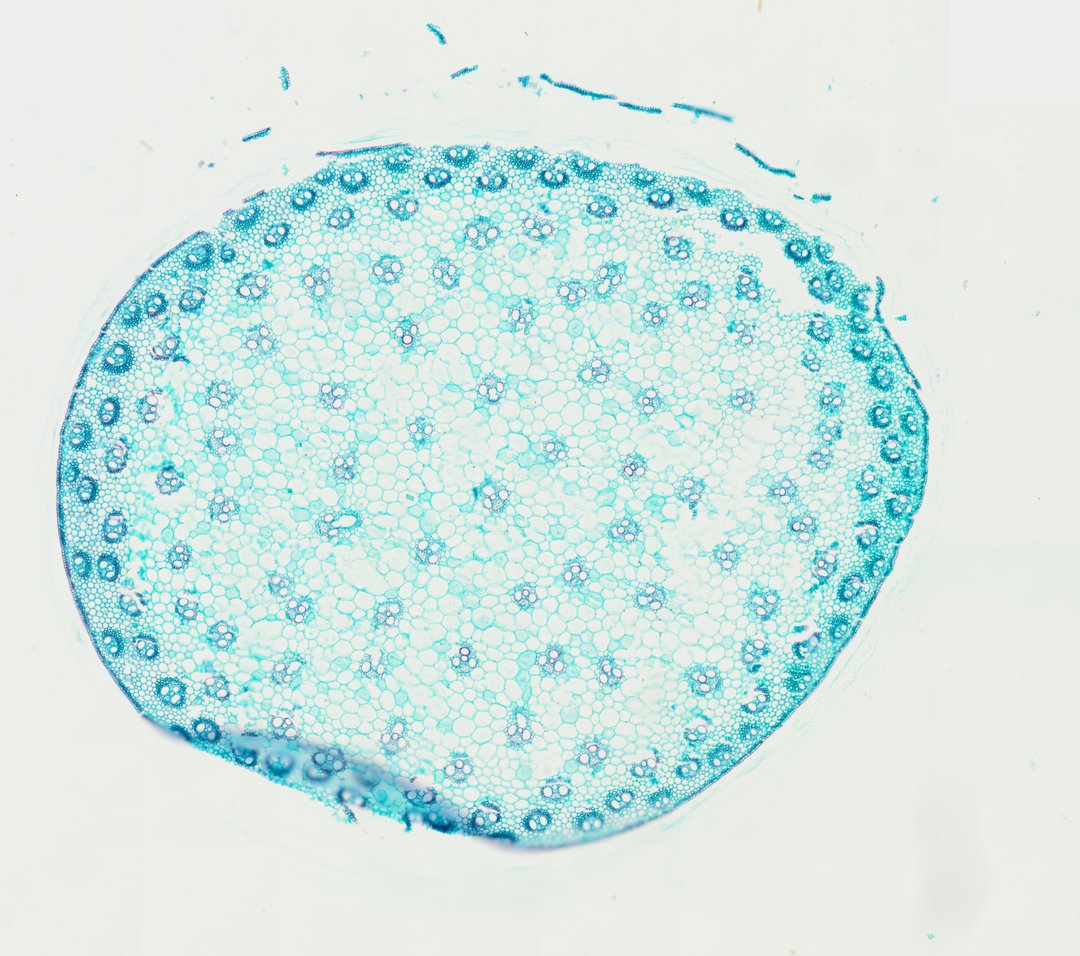 Corn Stem (Cross Section)Zea maysFast Green
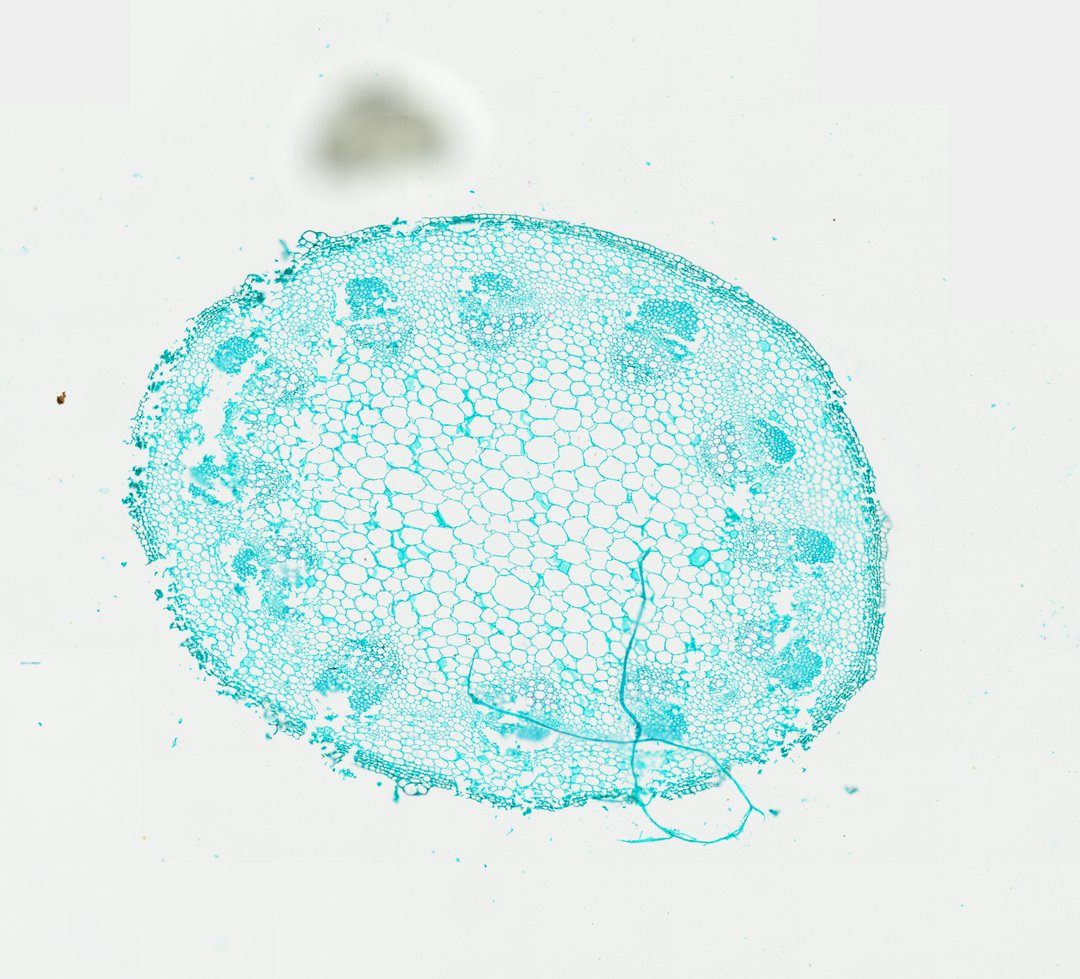 Sunflower Stem (Cross Section)Helianthus annuusFast Green
Monocot vs dicot stem at a glance
| Feature | Monocot stem (corn) | Dicot stem (sunflower) |
|---|---|---|
| Vascular bundles | Scattered through the whole stem, most crowded near the edge | One ring, about the same distance from the edge |
| Cortex and pith | No clear cortex or pith; ground tissue fills the stem between bundles | Cortex outside the ring of bundles, a large pith of big cells inside it |
| Shape of a bundle | Oval, with two large xylem vessels that look like a pair of eyes | Wedge-shaped, with a cap of thick-walled fibers on the outer side |
| Around each bundle | A sheath of thick-walled cells wraps the whole bundle | No full sheath; the fiber cap sits on the outside |
| Cambium | None in the bundles, so the stem does not grow wider with wood | A thin cambium between xylem and phloem, which can add width over time |
| Xylem and phloem | Xylem toward the center of the stem, phloem toward the outside | The same: xylem faces the center, phloem faces the outside |
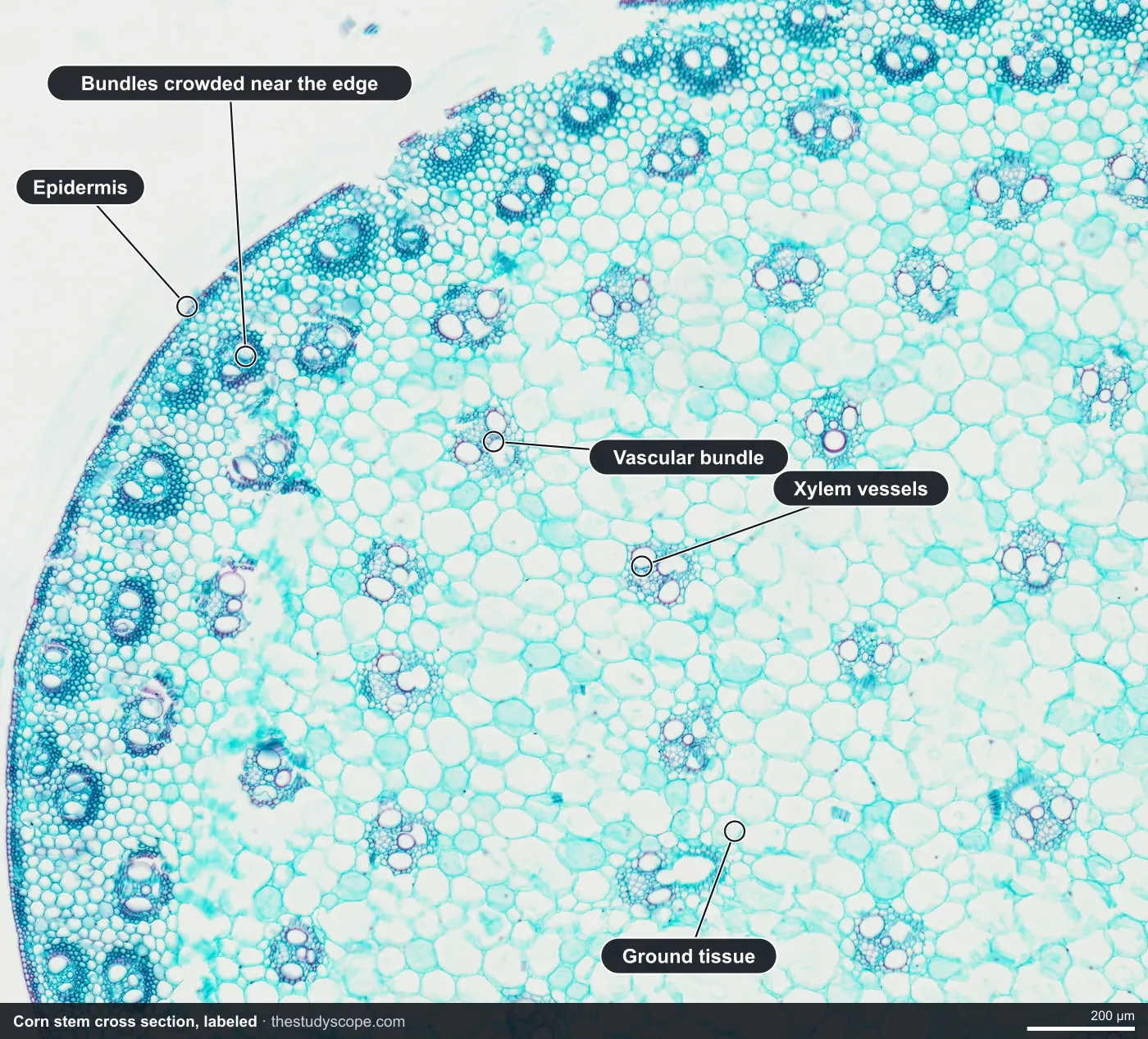
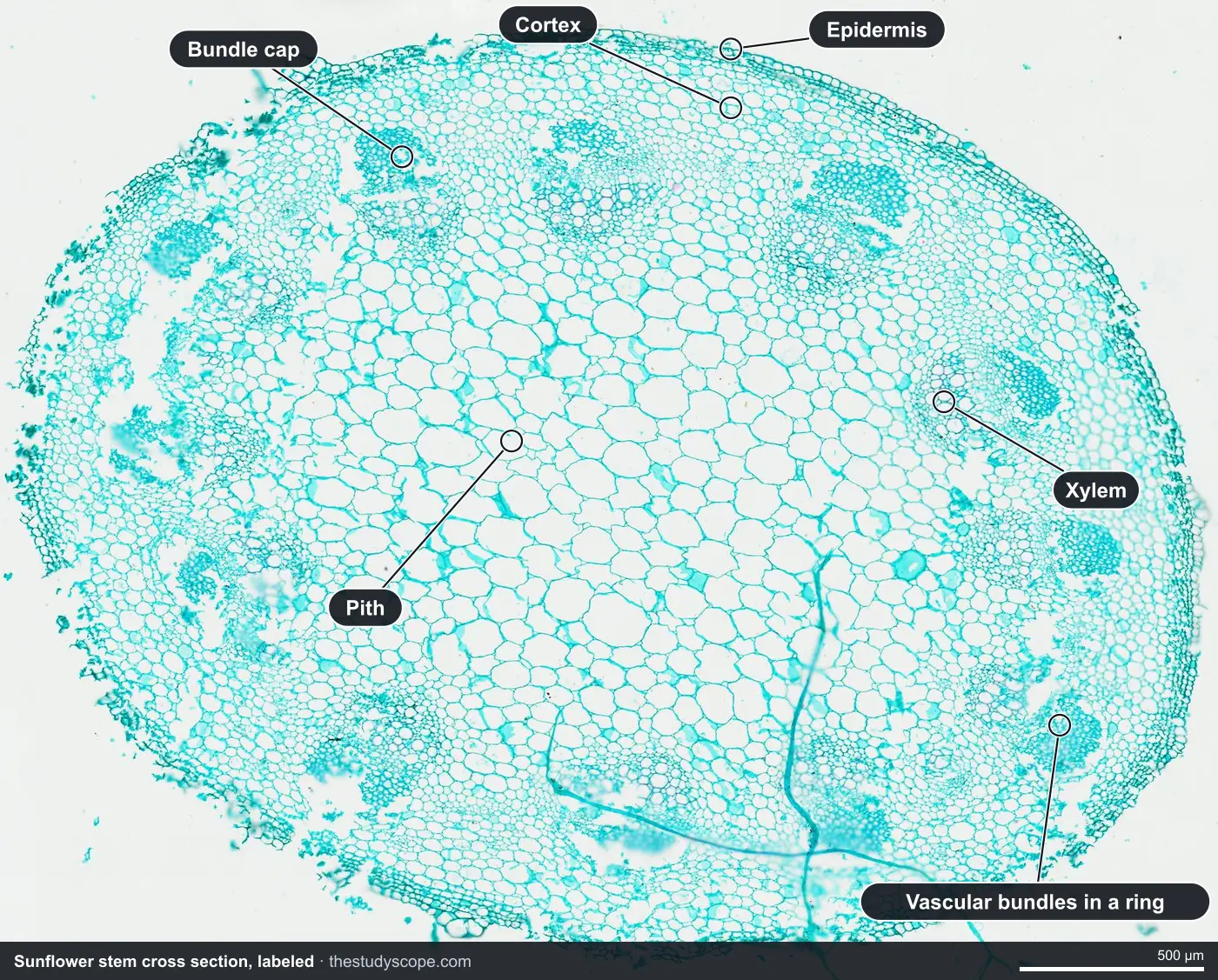
Labeled corn and sunflower stems
What to look for in the corn stem
- Scattered vascular bundles: many small ovals spread through the stem, packed closer together near the outer edge.
- Xylem vessels: two large, open vessels in each bundle, often with a smaller one between them. Students often say a bundle looks like a face or a skull.
- Phloem: a small cluster of cells on the outer side of each bundle.
- Bundle sheath: a ring of thick-walled cells around each bundle.
- Ground tissue: large, thin-walled parenchyma cells filling the space between bundles.
What to look for in the sunflower stem
- Epidermis: a single outer layer of cells.
- Cortex: a narrow zone of supporting and storage cells under the epidermis.
- Ring of vascular bundles: wedge-shaped bundles arranged in a circle.
- Xylem, cambium and phloem: xylem on the inner side of each bundle, phloem on the outer side, and a thin cambium between them.
- Pith: large, thin-walled cells filling the center of the stem.
More stems to compare
Corn and sunflower are the textbook pair, but a few other stems make good follow-up questions once students can tell those two apart:
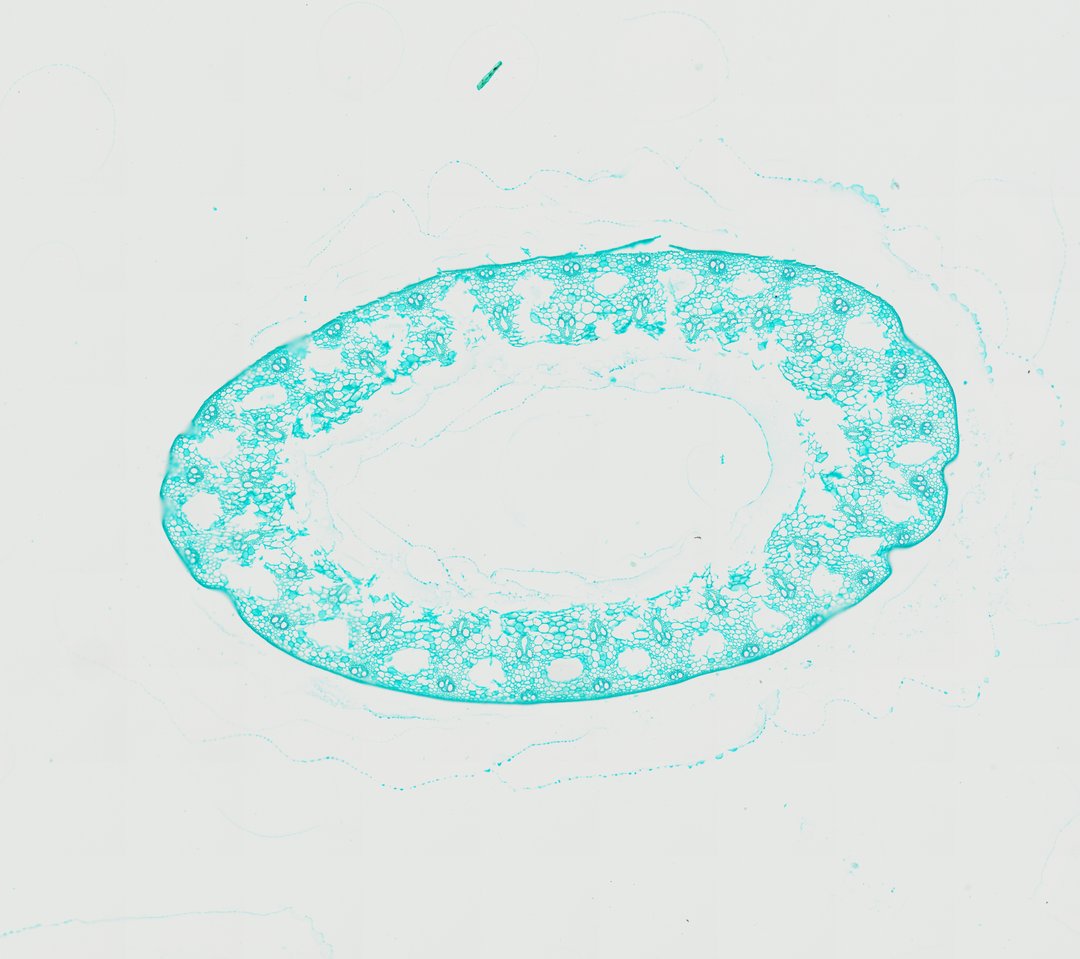
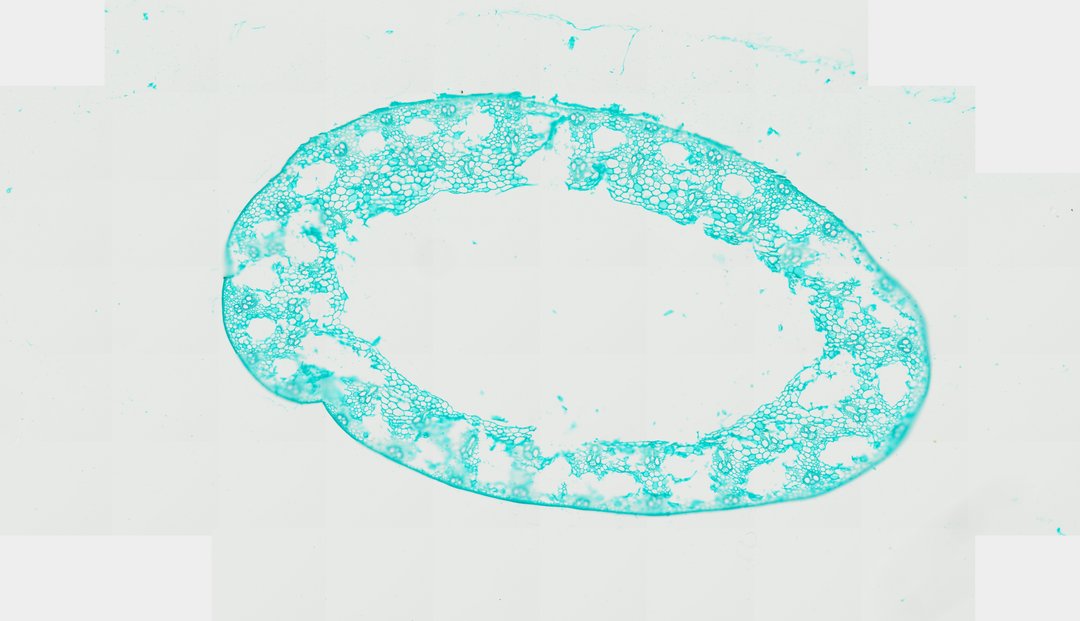
- Wheat stem and rice stem: monocots too, but grass stems are hollow, with bundles in rings around the hollow center. Rice adds large air spaces for growing in flooded fields. A good reminder that "scattered" describes corn best, not every monocot.
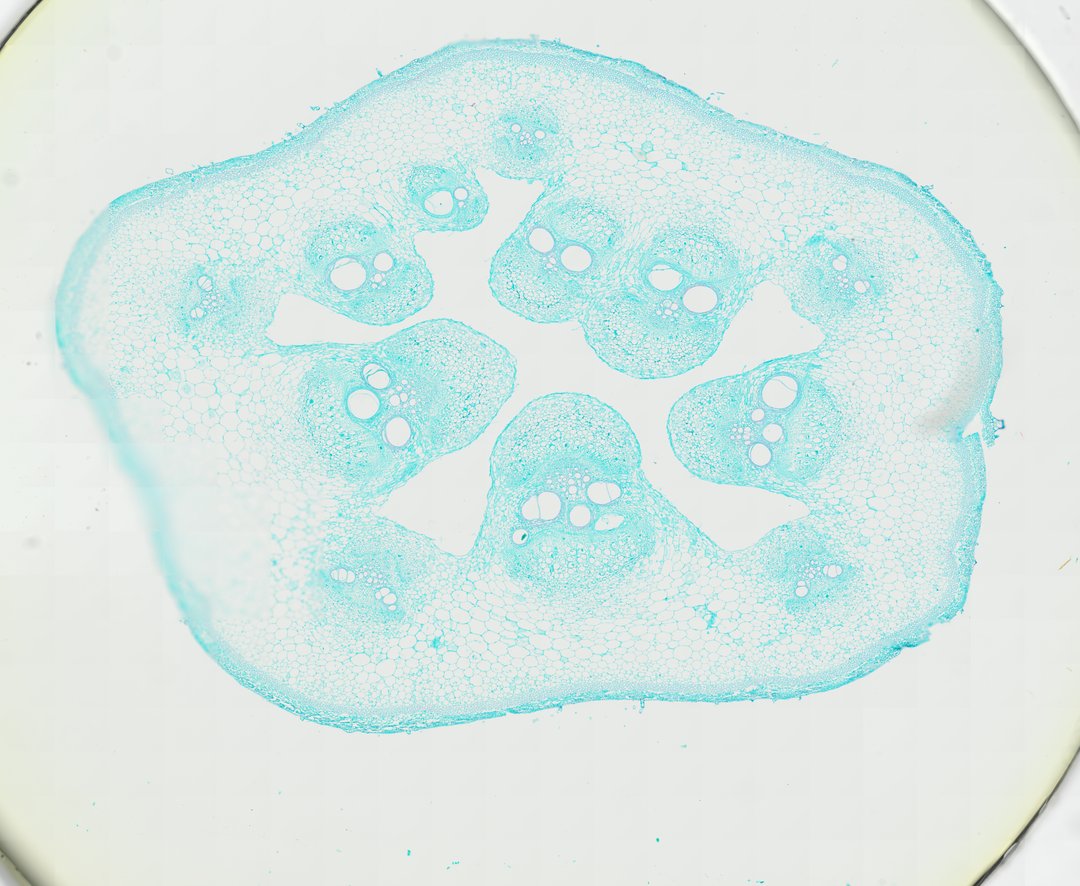
- Pumpkin stem: a dicot with bundles in two rings and phloem on both sides of the xylem (bicollateral bundles).
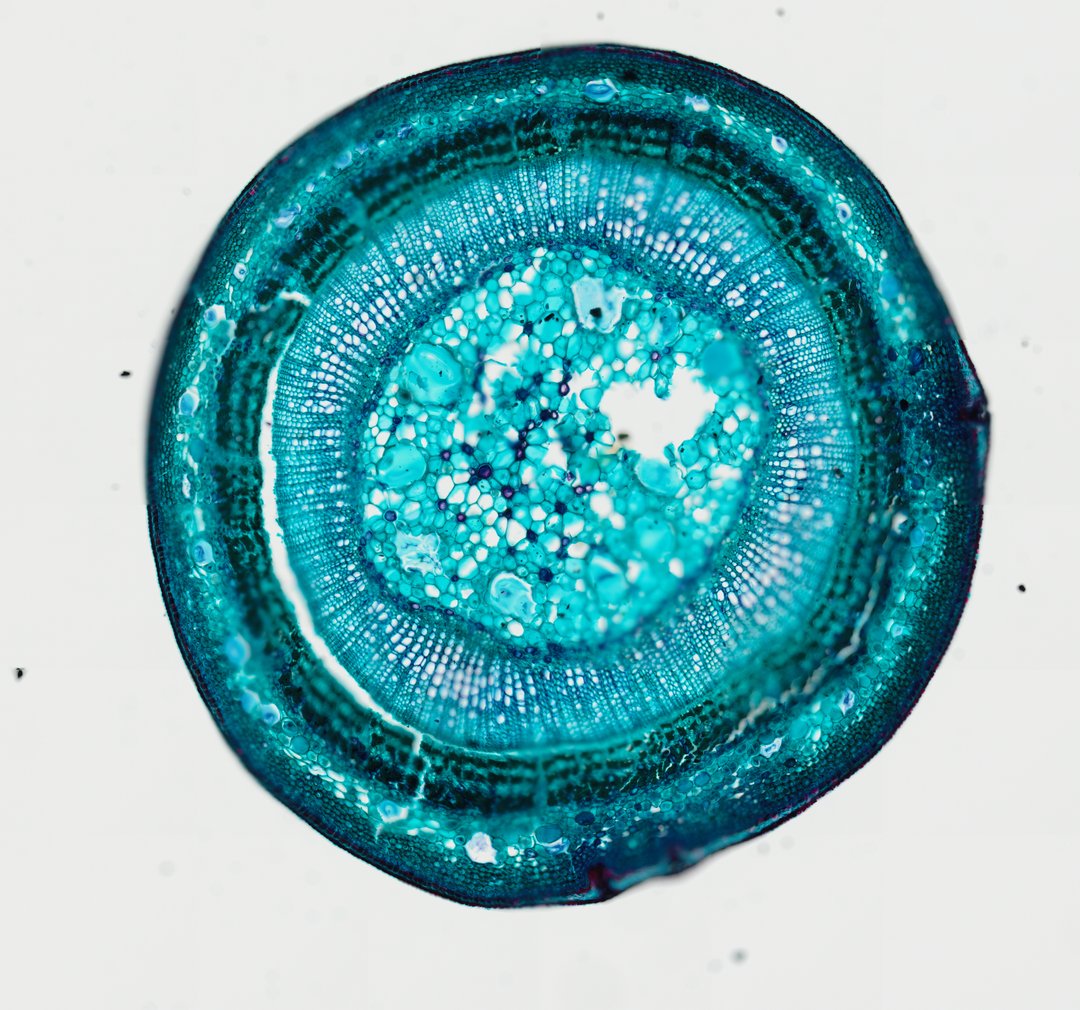
- Tilia (basswood) stem: a woody dicot, where the cambium has built rings of wood. It shows what a dicot stem's cambium can do that a monocot stem can't.
Monocot vs dicot beyond the stem
| Part | Monocots | Dicots |
|---|---|---|
| Seed | One seed leaf (cotyledon) | Two seed leaves |
| Leaf veins | Parallel | Branching, like a net |
| Roots | Fibrous roots; xylem and phloem in a ring around a pith | Often a taproot; xylem in a solid core, often star-shaped |
| Flower parts | Usually in threes | Usually in fours or fives |
Slides for these: a lily leaf (monocot) next to a sunflower leaf (dicot), a corn seed with its single cotyledon, and dicot roots such as radish and cotton.
Running the comparison in class
- Open both stems at the lowest zoom and ask students to sketch where the bundles are before you name anything.
- Ask which stem has a center that looks different from its edge. That is the pith, and only the sunflower has one.
- Zoom into one bundle in each stem and have students label xylem and phloem. Point out that both face the same way.
- Measure one bundle in each stem with the ruler. Every slide is calibrated, so the numbers are real micrometers.
- Finish with a stem students have not seen, like wheat or pumpkin, and ask them to decide: monocot or dicot?
Want it ready to teach? The premade lab Comparative Plant Anatomy: Monocot vs. Dicot walks a class through 15 slides, and you can present it live while every student screen follows.
Questions and answers
How can you tell a monocot stem from a dicot stem under a microscope?
Look at how the vascular bundles are arranged. A monocot stem like corn has bundles scattered throughout. A dicot stem like sunflower has its bundles in one ring, with a pith in the center and cortex outside the ring.
Is corn a monocot or a dicot?
Corn (Zea mays) is a monocot. Its stem has scattered vascular bundles, each wrapped in a sheath, and its seed has a single cotyledon.
Is sunflower a monocot or a dicot?
Sunflower (Helianthus annuus) is a dicot, more precisely a eudicot. Its stem shows the classic dicot plan: epidermis, cortex, a ring of vascular bundles, and a pith.
Why do dicot stems have a cambium and monocot stems do not?
The cambium is a thin layer of dividing cells between the xylem and phloem. In dicots it can make new xylem and phloem, so the stem grows wider, which is how woody stems form. Monocot bundles have no cambium, so most monocot stems do not grow wider in this way.
What magnification do you need to see vascular bundles?
Low power, about 4x, is enough to see how the bundles are arranged. Medium power, about 10x, shows the xylem vessels and phloem inside a single bundle.
More guides
- Frog, human, chicken and fish blood compared
- Virtual microscope, simulator or digital microscope?
- Using a microscope on a Chromebook
- How to identify the stages of mitosis in an onion root tip
- Cheek cells vs onion cells
- Leaf layers and stomata guide
- Pond water organisms identification guide
- How to identify tissue types
- How to measure cell size
- Lily, pine and luffa pollen compared
- Insect mouthparts compared
- Worm body cavities compared