Nerium indicum Leaf Cross Section Under the Microscope
Nerium indicum Leaf (Transverse Section), Nerium oleander
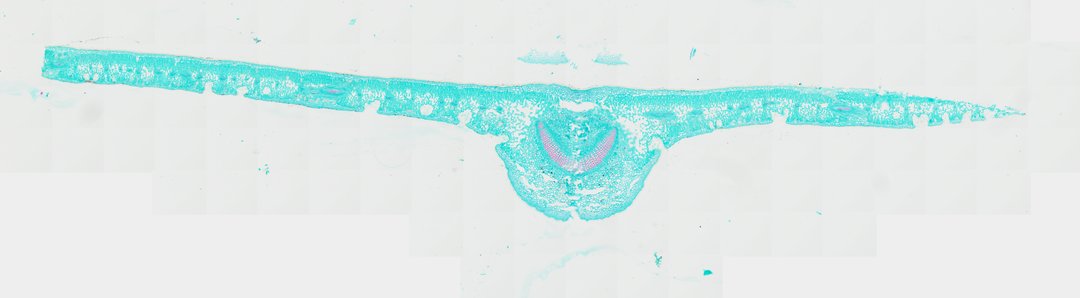
This is a cross section of an oleander leaf stained with safranin and fast green. Oleander grows in dry places, and its leaf shows several adaptations for saving water.
A transverse section of an oleander leaf (Nerium indicum T.S.) double-stained with Safranin and Fast Green, demonstrating classical xeromorphic anatomical features designed to limit transpiration. The upper adaxial surface features a multi-layered (multiple) epidermis covered by a thick, waxy protective cuticle. The ground tissue displays multiple rows of compactly arranged, columnar palisade mesophyll cells on the upper side, above a spongy mesophyll zone. On the abaxial (lower) epidermis, characteristic deep invaginations known as stomatal crypts (stomatal pits) are present, lined with protective non-glandular trichomes (hairs) and containing sunken stomata to create a humid microclimate. The large central midrib contains a well-defined, arc-shaped vascular bundle with prominent xylem vessels stained red with Safranin and surrounding phloem tissue.
What to look for
- Thick cuticle: A heavy waxy coating on the upper surface.
- Multiple epidermis: Several layers of epidermal cells on top instead of just one.
- Palisade mesophyll: Rows of tall, tightly packed cells under the upper epidermis.
- Stomatal crypts: Deep pits in the lower surface, lined with hairs, with stomata tucked inside.
- Midrib: A large central vein with red-stained xylem and green-stained phloem.
At each magnification
Low power (about 4x)
A thick leaf with a large midrib and pits along the lower edge.
Medium power (about 10x)
The layered epidermis and the hair-lined pits on the underside.
High power (about 40x)
Stomata inside the pits and the red xylem cells in the vein.
Questions and answers
How is an oleander leaf adapted to dry conditions?
Oleander leaves have a thick waxy cuticle, several layers of epidermis, and stomata hidden in hairy pits on the underside. The pits trap moist air around the stomata, so less water escapes.
What are stomatal crypts?
Stomatal crypts are sunken pits in the lower leaf surface that contain stomata and are lined with hairs. They are a classic feature of plants that live in dry places.
- Category
- Botany & Plants
- Scan magnification
- 20x
- Stain
- Safranin / Fast Green
- Tags
- Nerium indicum leaf, Nerium oleander, oleander leaf transverse section, xeromorphic leaf, stomatal crypts, sunken stomata
Viewing this slide in class
This is a scan of a real prepared slide, not a simulation or a drawing. On StudyScope you can pan from the whole slide down to individual structures, always in focus, and measure them in real micrometers with the calibrated ruler. Present it live and every student screen follows your view and annotations. Students join with a room code on Chromebooks, iPads, or any browser, with no accounts.