Rice Stem Cross Section Under the Microscope
Rice Stem (Cross Section), Oryza sativa
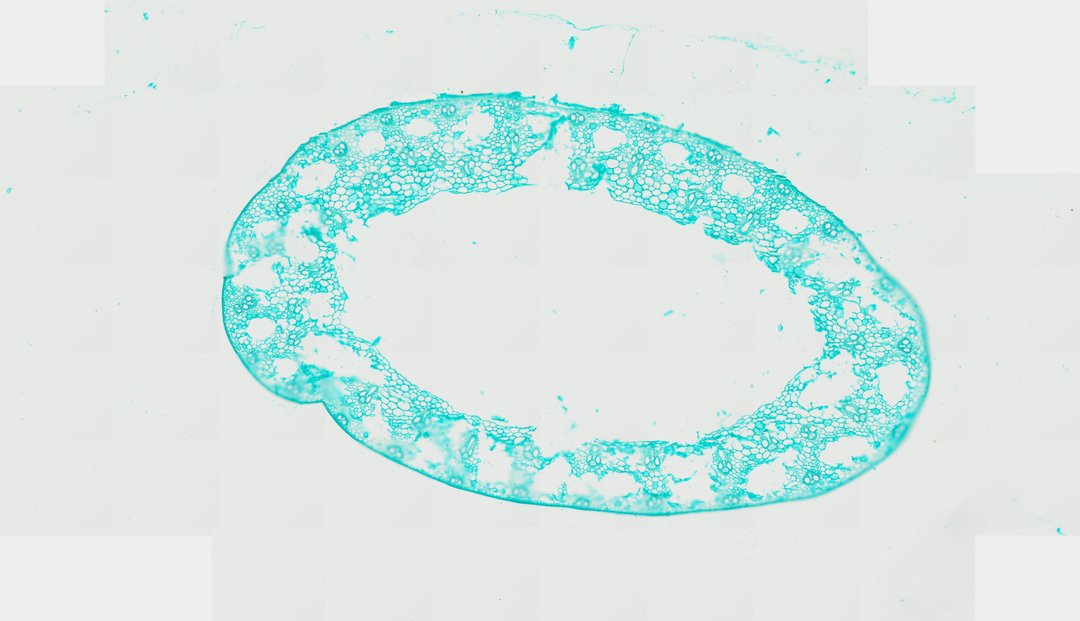
This is a cross section of a rice stem stained with fast green. Rice grows in flooded fields, and its stem has large air spaces that carry oxygen down to the roots.
A cross section of a rice stem (Oryza sativa stem c.s.) stained with Fast Green, exhibiting the specialized anatomical adaptations of a semi-aquatic monocotyledonous culm. The section displays a hollow central pith cavity surrounded by a ring of ground parenchyma tissue containing scattered closed collateral vascular bundles. Prominent large air spaces (aerenchyma lacunae) are distributed throughout the cortical region, facilitating internal gas exchange essential for survival in flooded, hypoxic environments. Each vascular bundle is reinforced by a sclerenchymatous sheath surrounding xylem vessels and phloem elements, enclosed externally by a protective epidermal layer.
What to look for
- Hollow center: A large empty space in the middle of the stem.
- Air spaces (aerenchyma): Large holes in the tissue around the stem, which let air move through the plant.
- Vascular bundles: Small oval bundles arranged around the stem, with xylem and phloem.
- Bundle sheath: A ring of thick-walled cells around each bundle.
- Epidermis: The outer layer of small cells.
At each magnification
Low power (about 4x)
A ring of tissue around a hollow center, with large holes in it.
Medium power (about 10x)
The air spaces and the vascular bundles between them.
High power (about 40x)
The xylem and phloem inside each bundle and the thick-walled sheath.
Questions and answers
Why does a rice stem have air spaces?
Rice grows with its roots in flooded, oxygen-poor soil. Large air spaces called aerenchyma let oxygen travel from the leaves down through the stem to the roots.
How is a rice stem like other grass stems?
Like wheat and other grasses, rice is a monocot with a hollow stem and vascular bundles with sheaths. The large air spaces are a special adaptation to living in water.
- Category
- Botany & Plants
- Scan magnification
- 20x
- Stain
- Fast Green
- Tags
- rice stem, Oryza sativa, rice stem cross section, monocot stem, aerenchyma, pith cavity
Viewing this slide in class
This is a scan of a real prepared slide, not a simulation or a drawing. On StudyScope you can pan from the whole slide down to individual structures, always in focus, and measure them in real micrometers with the calibrated ruler. Present it live and every student screen follows your view and annotations. Students join with a room code on Chromebooks, iPads, or any browser, with no accounts.