Sago Cycas Leaf Cross Section Under the Microscope
Sago Cycas Leaf (Cross Section), Cycas revoluta
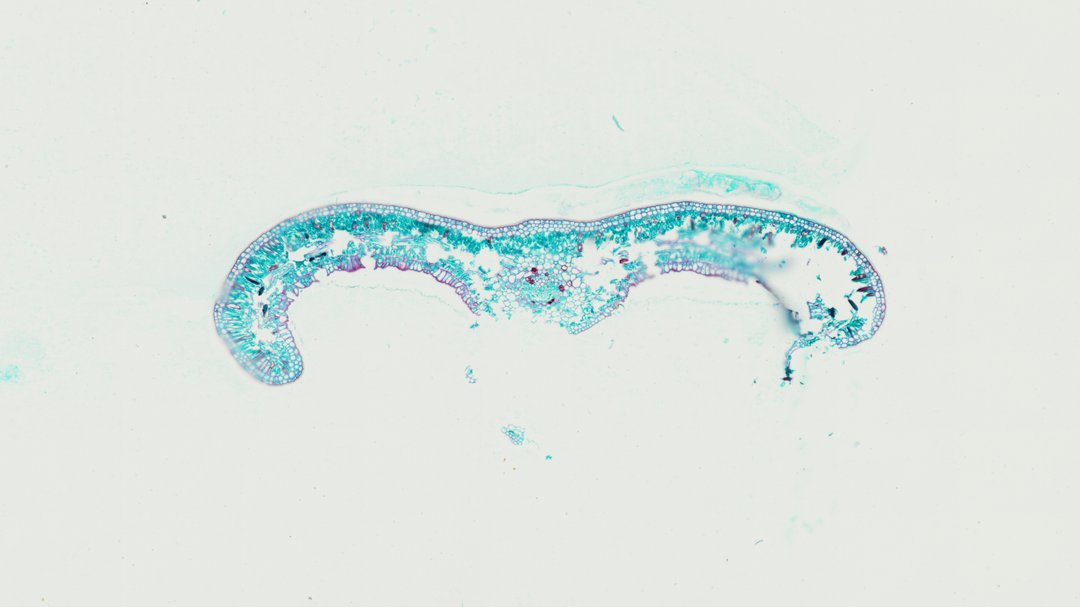
This is a cross section of a leaflet from the sago palm (Cycas), stained with safranin and fast green. Cycads are ancient seed plants, and their stiff leaflets show many features that help them save water.
A cross section of a sago palm leaflet (Cycas revoluta Leaf C.S.) double-stained with Safranin and Fast Green, demonstrating striking xeromorphic adaptations characteristic of gymnosperm foliage. The revolute margins curve downward at the lateral edges. A thick, protective cuticle covers the single-layered adaxial epidermis, supported underneath by a well-developed, sclerenchymatous hypodermis that provides mechanical strength and prevents desiccation. Sunken stomata with distinct guard cells are localized within the abaxial epidermis. Beneath the hypodermis, a continuous layer of columnar palisade mesophyll cells sits above a spongy mesophyll zone. Transfusion tissue with tracheid-like cells extends laterally from the single central vascular bundle, facilitating transverse transport of water and nutrients across the thick leaflet.
What to look for
- Thick cuticle: A heavy waxy layer on the upper surface.
- Hypodermis: Thick-walled, red-stained cells under the upper epidermis that make the leaflet stiff.
- Palisade mesophyll: A row of tall cells under the hypodermis.
- Spongy mesophyll: Looser cells with air spaces lower in the leaflet.
- Midrib vascular bundle: A single central vein, with red xylem.
- Sunken stomata: Stomata set into the lower surface.
At each magnification
Low power (about 4x)
A thick leaflet with a raised midrib and edges that curl downward.
Medium power (about 10x)
The red hypodermis layer and the palisade cells beneath it.
High power (about 40x)
The vascular bundle and the sunken stomata on the lower surface.
Questions and answers
What is a sago palm leaf like under a microscope?
A Cycas leaflet has a thick cuticle, a stiff layer of thick-walled hypodermis cells, palisade and spongy mesophyll, a single central vein, and sunken stomata on the underside. Its edges curl down.
Is a sago palm a real palm?
No. The sago palm is a cycad, an ancient group of seed plants related more closely to conifers than to true palms. It makes seeds in cones instead of flowers.
- Category
- Botany & Plants
- Scan magnification
- 20x
- Stain
- Safranin / Fast Green
- Tags
- sago cycas leaf, Cycas revoluta, sago cycas leaf cross section, cycad leaflet, gymnosperm leaf, xeromorphic leaf
Viewing this slide in class
This is a scan of a real prepared slide, not a simulation or a drawing. On StudyScope you can pan from the whole slide down to individual structures, always in focus, and measure them in real micrometers with the calibrated ruler. Present it live and every student screen follows your view and annotations. Students join with a room code on Chromebooks, iPads, or any browser, with no accounts.