Fish Scales Under the Microscope
Fish Scales (Whole Mount), Cyprinus carpio
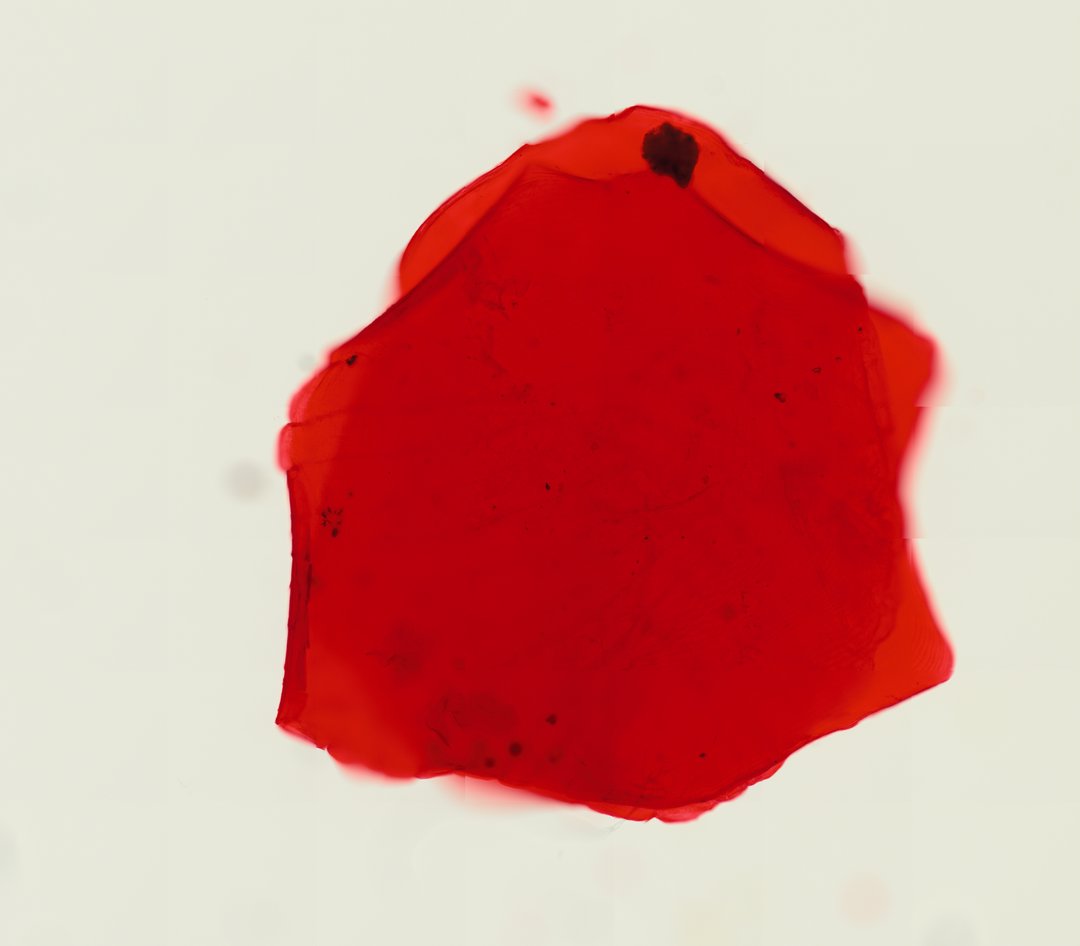
This is a fish scale mounted whole and stained with safranin. Fish scales have growth rings, a bit like tree rings, that scientists use to estimate a fish's age.
A whole mount (W.M.) preparation of fish scales (labeled Fish Scales W.M.). The slide shows a cycloid/ctenoid bony scale featuring distinct concentric growth rings (annuli) radiating from a central focus, illustrating osteichthyan integumentary structure.
What to look for
- Focus: The small central point where the scale first started growing.
- Circuli: Fine ridges that form rings around the focus.
- Annuli: Bands where the circuli are packed closer together, marking slower growth in winter.
- Radii: Lines or grooves running outward from the focus toward the edge.
- Scale edge: A smooth rounded edge in cycloid scales, or a toothed edge in ctenoid scales.
At each magnification
Low power (about 4x)
The whole scale with its rounded outline and ring pattern, stained pink to red.
Medium power (about 10x)
The spacing of the circuli and the darker bands of the annuli.
High power (about 40x)
Individual ridges and the texture of the scale edge.
Questions and answers
How can you tell a fish's age from its scale?
Fish grow faster in summer than in winter, so the ridges on a scale are spread out in summer and crowded together in winter. Each crowded band, called an annulus, usually marks one year.
What is the difference between cycloid and ctenoid fish scales?
Cycloid scales have a smooth, rounded edge, while ctenoid scales have tiny teeth along their rear edge. Carp, the species listed for this slide, have cycloid scales.
- Category
- Vertebrates
- Scan magnification
- 20x
- Stain
- Safranin
- Tags
- Fish Scales W.M., Fish scales w.m., Fish scales whole mount, Fish scales, Fish scale, Cyprinus carpio
Viewing this slide in class
This is a scan of a real prepared slide, not a simulation or a drawing. On StudyScope you can pan from the whole slide down to individual structures, always in focus, and measure them in real micrometers with the calibrated ruler. Present it live and every student screen follows your view and annotations. Students join with a room code on Chromebooks, iPads, or any browser, with no accounts.