Antenna of Butterfly Under the Microscope
Antenna of Butterfly (Whole Mount), Lepidoptera
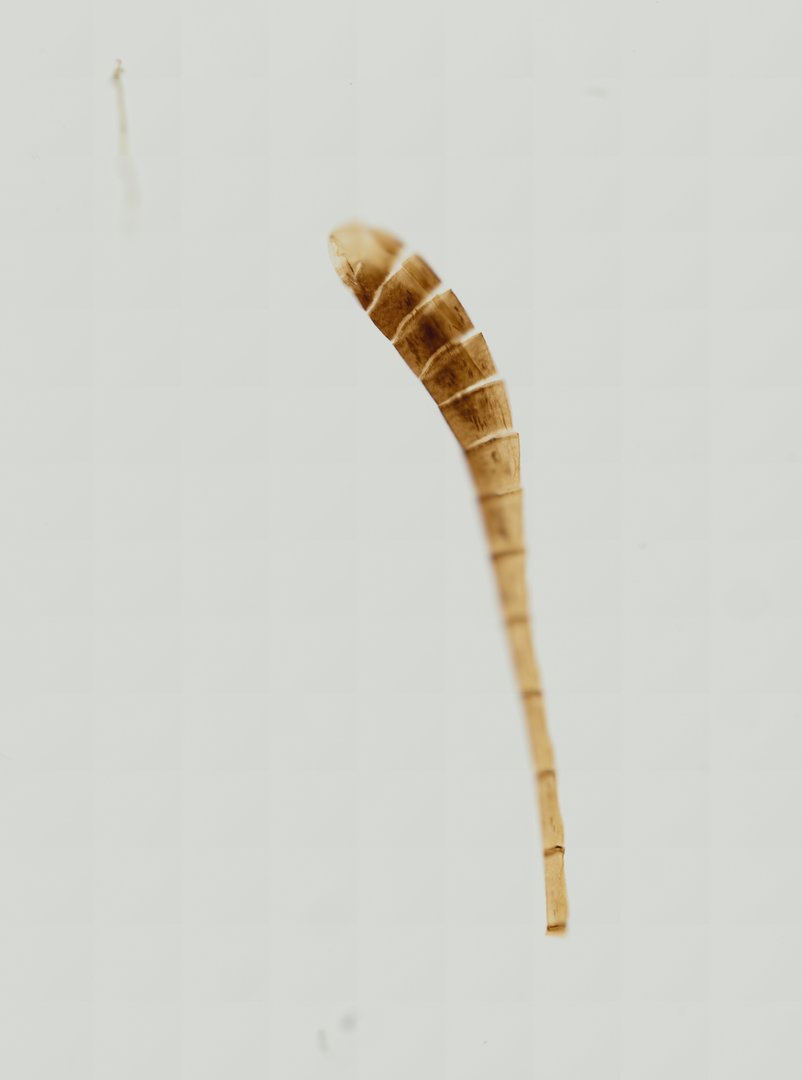
This slide shows a single butterfly antenna mounted whole. Students use it to see the clubbed tip that helps tell butterflies apart from most moths.
A whole mount preparation of a butterfly antenna displaying the characteristic capitate morphology. The specimen illustrates the segmented flagellum terminating in an enlarged, clubbed distal tip (clava), a key diagnostic feature distinguishing butterfly antennae from the filiform or pectinate antennae typical of most moths. Individual flagellomeres are clearly defined, showing chitinous cuticle structural organization along the shaft.
What to look for
- Club (clava): The thickened, rounded tip at the end of the antenna.
- Flagellum: The long, thin shaft made of many small, ring-like segments.
- Segments (flagellomeres): Repeating short sections along the shaft, separated by faint lines.
- Cuticle: The tough outer covering, which gives the antenna its natural tan to brown color.
At each magnification
Low power (about 4x)
The whole antenna, a long thin shaft ending in a swollen club.
Medium power (about 10x)
The repeating segments along the shaft and the shape of the club.
High power (about 40x)
Surface texture of the cuticle and any small scales or hairs on the segments.
Questions and answers
How can you tell a butterfly antenna from a moth antenna under a microscope?
Most butterfly antennae are thin shafts that end in a rounded club. Most moth antennae are either thread-like with no club or feathery, with many side branches. It is a handy rule of thumb, though a few species break it.
What do butterfly antennae do?
Antennae are sense organs. Butterflies use them to smell, to sense air movement, and to help with balance and direction during flight.
- Category
- Invertebrates
- Scan magnification
- 20x
- Tags
- Antenna of butterfly, Butterfly antenna, Lepidoptera, Insect antenna, Capitate antenna, Clubbed antenna
Viewing this slide in class
This is a scan of a real prepared slide, not a simulation or a drawing. On StudyScope you can pan from the whole slide down to individual structures, always in focus, and measure them in real micrometers with the calibrated ruler. Present it live and every student screen follows your view and annotations. Students join with a room code on Chromebooks, iPads, or any browser, with no accounts.