Cyclops Under the Microscope
Cyclops (Whole Mount), Cyclops sp.
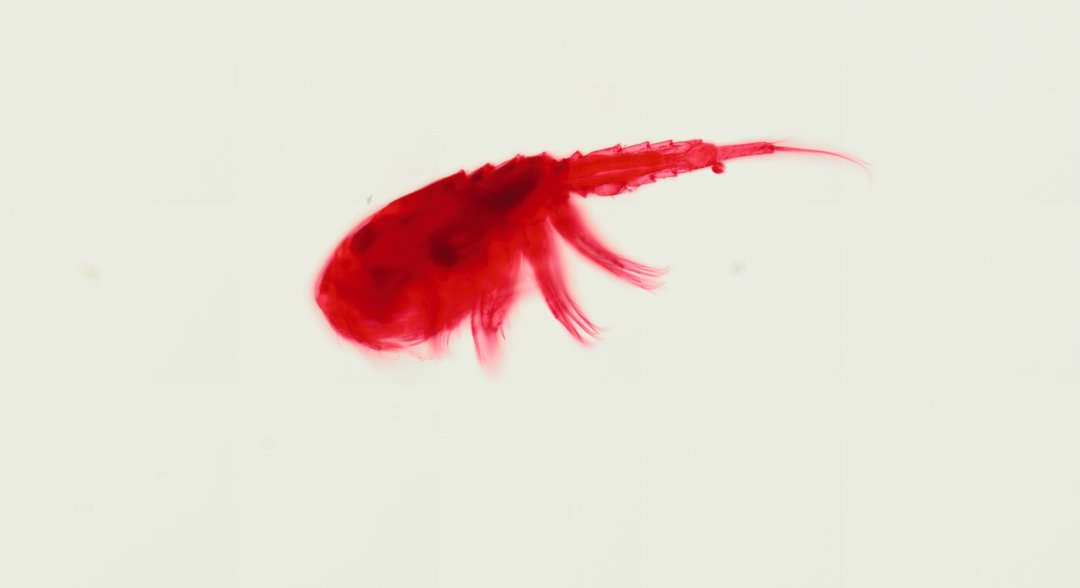
This is a whole Cyclops, a tiny freshwater crustacean called a copepod, stained red with safranin. Cyclops is common in pond water and is used to teach about zooplankton and crustacean body plans.
A whole mount (W.M.) preparation of the freshwater copepod Cyclops, stained red for anatomical clarity. The specimen displays the characteristic pear-shaped cephalothorax (prosoma) transitioning into a narrower, segmented abdomen (urosome) terminating in caudal rami with fine setae. Prominent jointed antennules project from the anterior region alongside thoracic swimming legs used for locomotion, highlighting typical microcrustacean morphology.
What to look for
- Cephalothorax: The wide, pear-shaped front part of the body.
- Antennules: A long pair of jointed antennae sticking out from the front, used for sensing and swimming.
- Swimming legs: Small paired legs under the front body that push the animal through water.
- Abdomen (urosome): The narrow, segmented tail section behind the wider front.
- Caudal rami: Two small forks at the end of the tail, each tipped with long bristles.
- Egg sacs: Females often carry a pair of egg sacs attached near the base of the tail.
At each magnification
Low power (about 4x)
The whole teardrop-shaped body with its long antennules and forked tail.
Medium power (about 10x)
Body segments, swimming legs, and any egg sacs.
High power (about 40x)
The bristles on the tail forks and joints of the antennules.
Questions and answers
What does Cyclops look like under a microscope?
Cyclops has a wide, teardrop-shaped front body, a narrow segmented tail ending in two bristly forks, and a pair of long antennae. It is usually a millimeter or two long, so it is just visible to the naked eye as a moving speck.
Why is it called Cyclops?
It is named after the one-eyed giant of Greek myth because it has a single eye in the middle of its head.
- Category
- Invertebrates
- Scan magnification
- 20x
- Stain
- Safranin
- Tags
- Cyclops whole mount, Cyclops W.M., Cyclops, Copepod, Crustacea, Arthropoda
Viewing this slide in class
This is a scan of a real prepared slide, not a simulation or a drawing. On StudyScope you can pan from the whole slide down to individual structures, always in focus, and measure them in real micrometers with the calibrated ruler. Present it live and every student screen follows your view and annotations. Students join with a room code on Chromebooks, iPads, or any browser, with no accounts.