Drosophila Under the Microscope
Drosophila (Whole Mount), Drosophila melanogaster
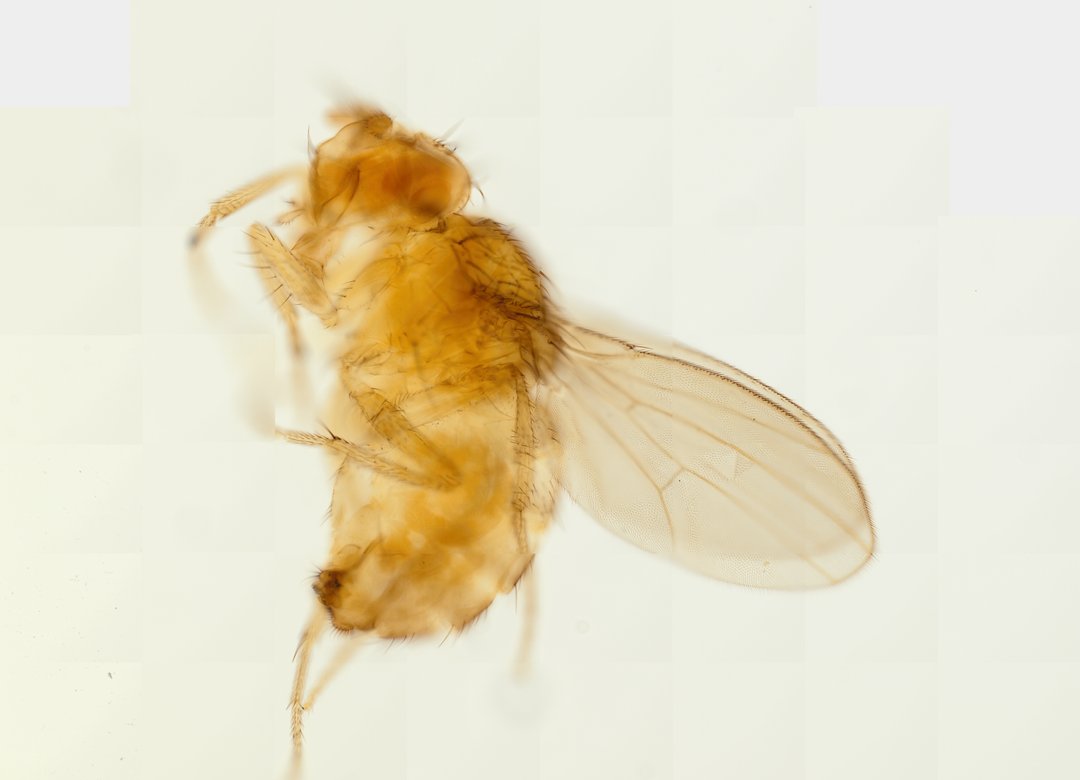
This is a whole adult fruit fly, Drosophila melanogaster, mounted on its side. Fruit flies are the famous model organism of genetics, so students often learn their body parts before doing crosses.
A whole mount preparation of an adult fruit fly, Drosophila melanogaster, viewed in lateral orientation under brightfield microscopy. The specimen displays key anatomical structures of Diptera, including a distinct head with large compound eyes, prominent thoracic macrochaetae (bristles), jointed appendages, and a segmentally organized abdomen. The membranous forewing extends posterolaterally, clearly exhibiting characteristic venation patterns including major longitudinal veins and crossveins essential for dipteran taxonomy.
What to look for
- Compound eyes: Large rounded eyes on the sides of the head, made of many small units.
- Bristles: Stiff dark hairs on the thorax and head, arranged in a regular pattern.
- Wings: Clear wings with a simple pattern of veins.
- Legs: Six jointed legs attached to the thorax.
- Abdomen: The rear section, with visible bands where segments meet.
At each magnification
Low power (about 4x)
The whole fly with head, thorax, abdomen, and wings.
Medium power (about 10x)
The wing veins, leg segments, and bristle pattern.
High power (about 40x)
The texture of the compound eye and the bases of the bristles.
Questions and answers
How do you tell male and female fruit flies apart under a microscope?
Males are usually smaller, with a darker, rounded tip on the abdomen and a small row of dark bristles called a sex comb on each front leg. Females are larger, with a more pointed abdomen and lighter striping.
Why are fruit flies used in genetics?
Fruit flies breed quickly, are easy to keep, and have many visible traits like eye color and wing shape. Scientists have studied their genes for more than a century, so much is known about them.
- Category
- Invertebrates
- Scan magnification
- 20x
- Tags
- Drosophila melanogaster, Drosophila, Fruit fly, Whole mount, Insect anatomy, Diptera
Viewing this slide in class
This is a scan of a real prepared slide, not a simulation or a drawing. On StudyScope you can pan from the whole slide down to individual structures, always in focus, and measure them in real micrometers with the calibrated ruler. Present it live and every student screen follows your view and annotations. Students join with a room code on Chromebooks, iPads, or any browser, with no accounts.