House Fly Wing Under the Microscope
House Fly Wing (Whole Mount), Musca domestica
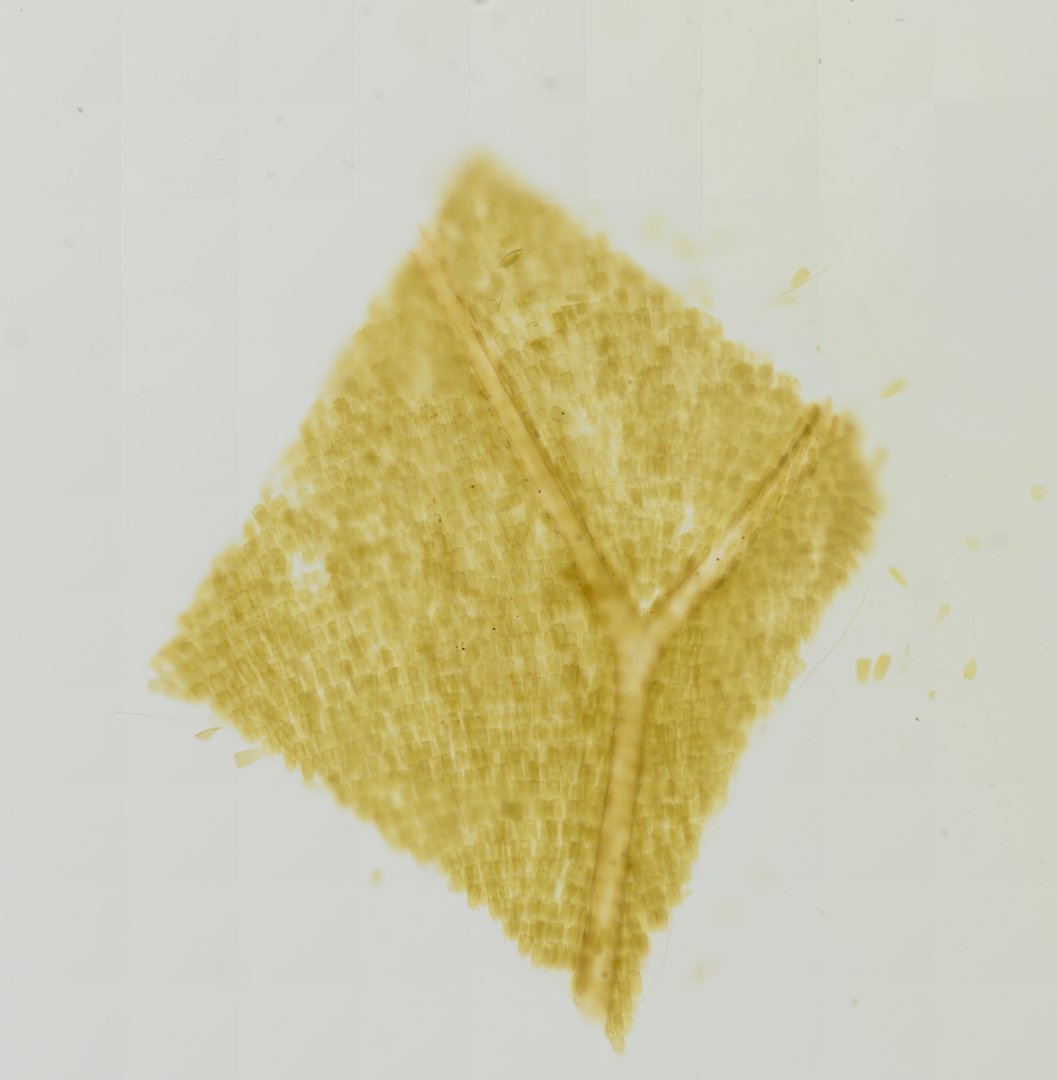
This is a house fly wing mounted whole and unstained. Flies have only one pair of wings, and the vein pattern of this wing is a classic example used in insect identification.
A whole mount (W.M.) preparation of a house fly wing. The slide illustrates translucent dipteran wing membrane with distinct venation patterns, including the characteristic sharply angled fourth longitudinal vein (M1), along with fine microtrichia dispersed across the wing surface.
What to look for
- Wing membrane: The clear sheet of the wing.
- Longitudinal veins: Long veins running from the base toward the tip.
- Bent vein: In house flies, one of the main veins bends sharply forward near the wing tip.
- Cross veins: A few short veins connecting the long veins.
- Microtrichia: Tiny hairs covering the membrane, visible at high power.
At each magnification
Low power (about 4x)
The wing outline and the main veins.
Medium power (about 10x)
The pattern of veins, including the sharp forward bend near the tip.
High power (about 40x)
The tiny hairs on the membrane and along the veins.
Questions and answers
How many wings does a house fly have?
A house fly has one pair of wings. The second pair has become small knob-like structures called halteres, which help the fly balance in flight.
What does a house fly wing look like under a microscope?
A house fly wing is a clear membrane with a simple set of veins and tiny hairs covering the surface. One main vein bends sharply forward near the tip, a feature used to recognize house flies.
- Category
- Invertebrates
- Scan magnification
- 20x
- Stain
- Unstained
- Tags
- House fly wing whole mount, House Fly Wing W.M., Musca domestica, House fly, Diptera, Muscidae
Viewing this slide in class
This is a scan of a real prepared slide, not a simulation or a drawing. On StudyScope you can pan from the whole slide down to individual structures, always in focus, and measure them in real micrometers with the calibrated ruler. Present it live and every student screen follows your view and annotations. Students join with a room code on Chromebooks, iPads, or any browser, with no accounts.