Housefly Antenna Under the Microscope
Housefly Antenna (Whole Mount), Musca domestica
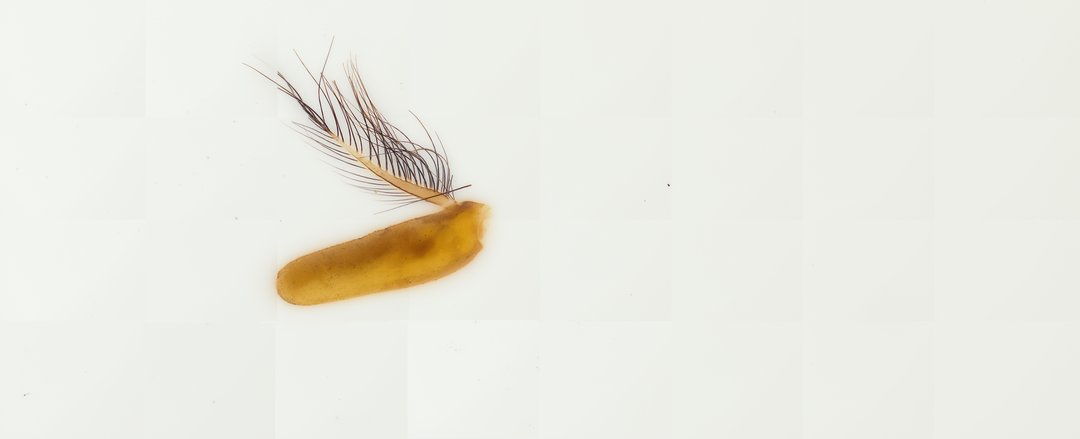
This is a house fly antenna mounted whole. Fly antennae are short and have a feathery bristle called the arista, which senses air currents and smells.
This whole mount preparation displays the aristate antenna morphology characteristic of higher flies (order Diptera, suborder Brachycera, family Muscidae). The specimen features a enlarged, elongated third antennal segment (postpedicel) from which a feather-like, plumose arista arises dorsally. The arista is fringed with fine sensory hairs (setae) on both the upper and lower margins, serving as a specialized olfactory and mechanosensory organ designed to detect air currents, wind speed, and chemical gradients. Under brightfield illumination, the amber-colored, chitinous exoskeleton and fine cuticular sensilla are clearly visible, illustrating key diagnostic structures used in dipteran taxonomy and sensory neurobiology.
What to look for
- Basal segments: Two small segments where the antenna joins the head.
- Third segment: A larger, elongated segment that makes up most of the antenna.
- Arista: A long bristle growing from the side of the third segment.
- Arista hairs: Fine hairs along the arista that make it look feathery.
At each magnification
Low power (about 4x)
The short antenna with a long bristle sticking out.
Medium power (about 10x)
The third segment and the feathery arista.
High power (about 40x)
The fine hairs on the arista and sensory pits on the third segment.
Questions and answers
What is an arista on a fly antenna?
The arista is a bristle that sticks out from the third segment of the antenna in house flies and their relatives. It is often feathery and helps the fly sense air movement and smells.
How is a fly antenna different from a bee antenna?
A fly antenna is short, with a large third segment and a bristle called the arista. A bee antenna is long and elbowed, with a flagellum made of many small segments.
- Category
- Invertebrates
- Scan magnification
- 20x
- Tags
- housefly antenna, Musca domestica, aristate antenna, arista, postpedicel, plumose arista
Viewing this slide in class
This is a scan of a real prepared slide, not a simulation or a drawing. On StudyScope you can pan from the whole slide down to individual structures, always in focus, and measure them in real micrometers with the calibrated ruler. Present it live and every student screen follows your view and annotations. Students join with a room code on Chromebooks, iPads, or any browser, with no accounts.