Mosquito Leg Under the Microscope
Mosquito Leg (Whole Mount), Culex sp.
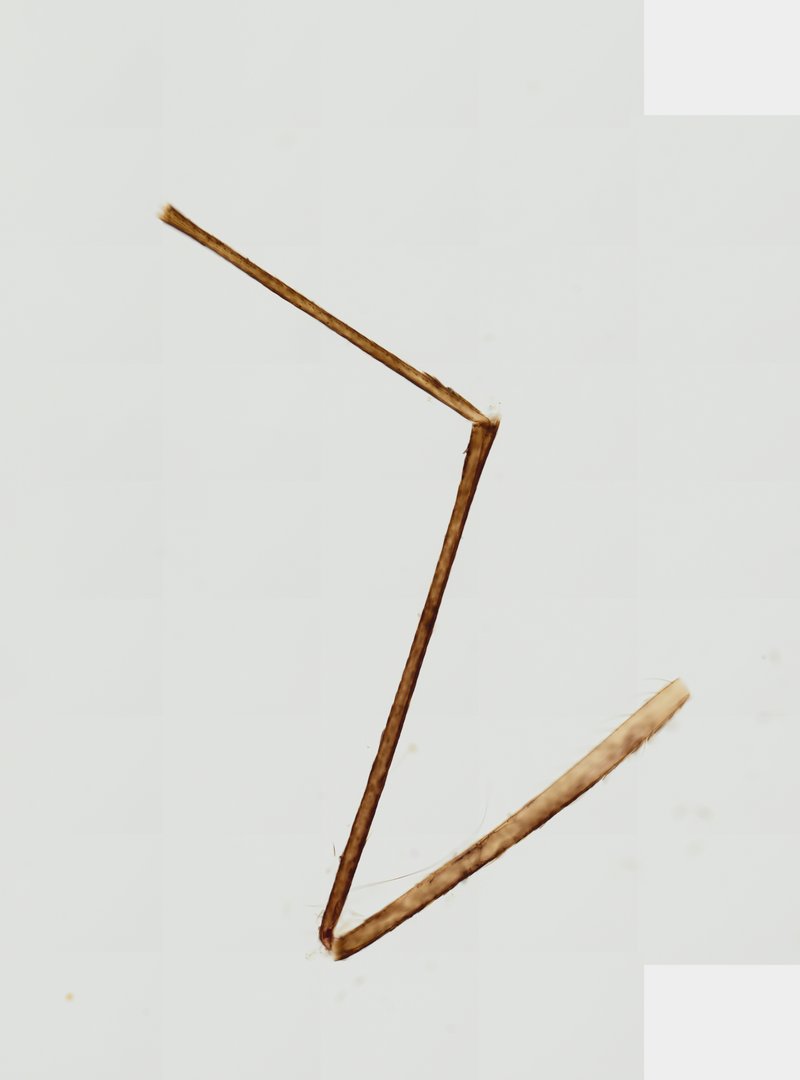
This is a mosquito leg mounted whole and unstained. Mosquito legs are very long and thin and covered in scales, a good example of how leg shape differs among insects.
A whole mount (W.M.) preparation of a mosquito leg. The slide demonstrates the typical long, slender, multi-segmented leg structure characteristic of culicids, showing dark chitinous scaling and fine setae along the femur, tibia, and tarsal segments.
What to look for
- Femur: A long segment near the body end of the leg.
- Tibia: A long, thin segment after the femur.
- Tarsus: A long chain of foot segments making up much of the leg's length.
- Scales: Tiny dark flat scales covering the leg.
- Claws: Small claws at the very tip.
At each magnification
Low power (about 4x)
A long, slender leg that may run across much of the view.
Medium power (about 10x)
The joints between segments and the dark scale covering.
High power (about 40x)
Individual scales and fine hairs along the leg.
Questions and answers
What does a mosquito leg look like under a microscope?
A mosquito leg is long, thin, and jointed, with a femur, tibia, and long tarsus ending in small claws. It is covered with tiny scales that give it a dark, sometimes banded look.
Why are mosquito legs covered in scales?
The scales help repel water, which lets mosquitoes stand on the surface of water to lay eggs without sinking. Scale patterns also help scientists identify mosquito species.
- Category
- Invertebrates
- Scan magnification
- 20x
- Stain
- Unstained
- Tags
- Mosquito leg whole mount, Mosquito Leg W.M., Culex, Mosquito, Diptera, Culicidae
Viewing this slide in class
This is a scan of a real prepared slide, not a simulation or a drawing. On StudyScope you can pan from the whole slide down to individual structures, always in focus, and measure them in real micrometers with the calibrated ruler. Present it live and every student screen follows your view and annotations. Students join with a room code on Chromebooks, iPads, or any browser, with no accounts.