Pollen-Carrying Leg of Honeybee Under the Microscope
Pollen-Carrying Leg of Honeybee (Whole Mount), Apis mellifera
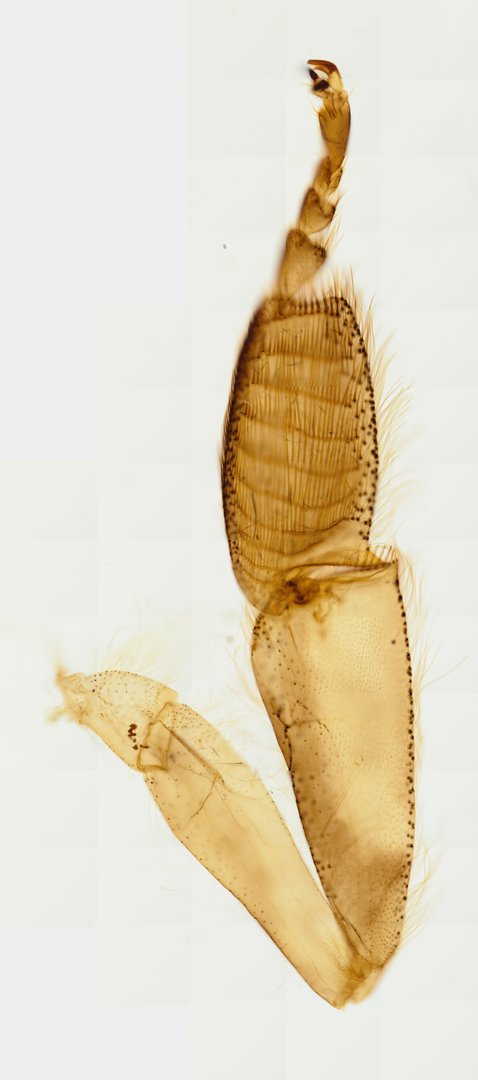
This is the hind leg of a worker honeybee, mounted whole and unstained. It shows the pollen basket and combs bees use to collect and carry pollen back to the hive.
A whole mount (W.M.) preparation of a worker honeybee hind leg specialized for foraging. The slide clearly shows the corbicula (pollen basket) on the outer flattened surface of the tibia bounded by stiff bristles, along with the enlarged basitarsus bearing pollen combs (transverse rows of stiff setae) used to collect and pack pollen grains.
What to look for
- Pollen basket (corbicula): A smooth, slightly hollow area on the outer side of the tibia, framed by long curved hairs.
- Tibia: The wide, flat leg segment holding the pollen basket.
- Basitarsus: The large first foot segment, wide and flat.
- Pollen combs: Rows of stiff bristles on the inner side of the basitarsus used to comb pollen off the body.
- Tarsal claws: Small claws at the tip of the leg.
At each magnification
Low power (about 4x)
The whole leg, with its wide flat tibia and basitarsus.
Medium power (about 10x)
The pollen basket and the fringe of hairs around it.
High power (about 40x)
The rows of stiff bristles in the pollen combs.
Questions and answers
What is a pollen basket on a honeybee?
The pollen basket, or corbicula, is a smooth, slightly hollow area on the hind leg surrounded by long curved hairs. Bees pack pollen into it and carry it back to the hive as a small pellet.
How do honeybees collect pollen?
Pollen sticks to the bee's hairy body while it visits flowers. The bee combs the pollen off with bristles on its legs, moistens it with nectar, and presses it into the pollen baskets on its hind legs.
- Category
- Invertebrates
- Scan magnification
- 20x
- Stain
- Unstained
- Tags
- Pollen-carrying leg of Honeybee W.M., Pollen-carrying leg of Honeybee, Honeybee hind leg whole mount, Apis mellifera, Honeybee, Hymenoptera
Viewing this slide in class
This is a scan of a real prepared slide, not a simulation or a drawing. On StudyScope you can pan from the whole slide down to individual structures, always in focus, and measure them in real micrometers with the calibrated ruler. Present it live and every student screen follows your view and annotations. Students join with a room code on Chromebooks, iPads, or any browser, with no accounts.