Honeybee Mouthparts Under the Microscope
Honeybee Mouthparts (Whole Mount), Apis mellifera
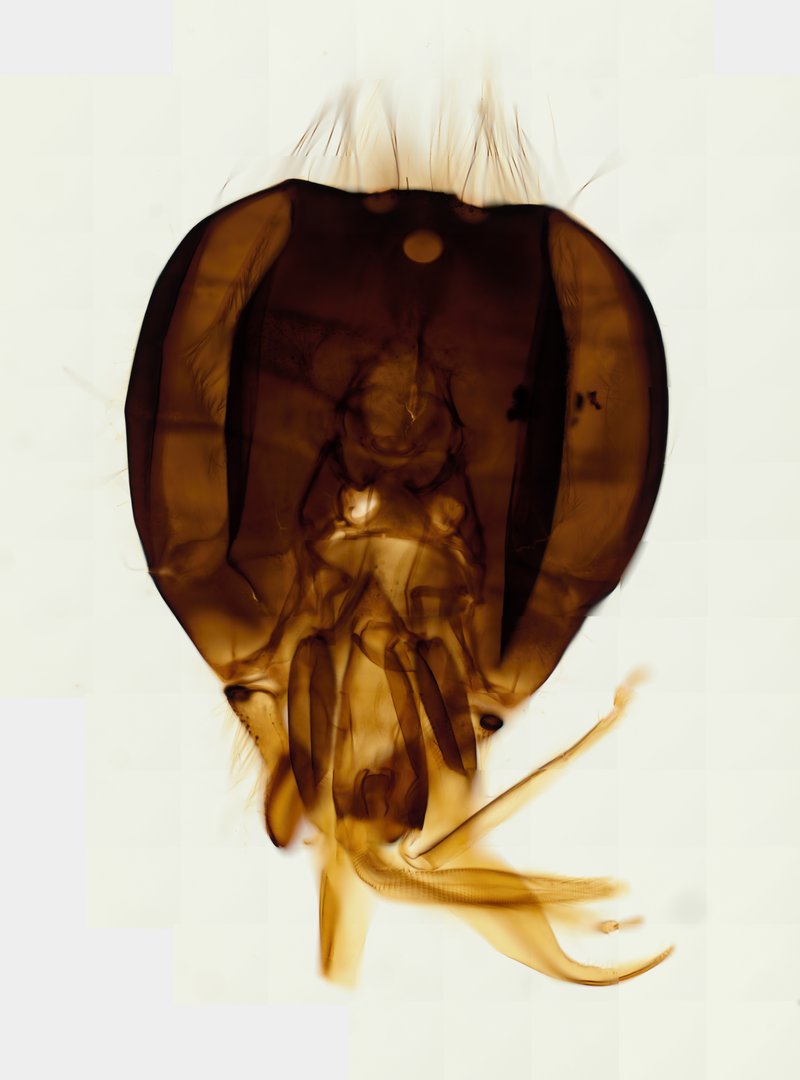
This slide shows the head and mouthparts of a honeybee, mounted whole and unstained. Bees have chewing-lapping mouthparts: jaws for handling wax and a long tongue for drinking nectar.
A whole mount (W.M.) preparation of the head and chewing-lapping mouthparts of a honeybee, Apis mellifera. The slide reveals the large compound eyes flanking the head capsule, ocelli near the vertex, and the elongated, specialized labium (glossae forming the central tongue surrounded by labial palps) and maxillae modified for harvesting nectar and pollen.
What to look for
- Compound eyes: Two large eyes on the sides of the head.
- Ocelli: Three small simple eyes on top of the head, if the head is included.
- Mandibles: A pair of jaws used for shaping wax and handling pollen.
- Glossa (tongue): The long, hairy central tongue used to lap up nectar.
- Labial palps and maxillae: Long parts beside the tongue that together form a tube around it.
At each magnification
Low power (about 4x)
The head with the long bundle of mouthparts hanging below.
Medium power (about 10x)
The tongue, the palps, and the maxillae beside it.
High power (about 40x)
The fine hairs along the tongue.
Questions and answers
What type of mouthparts do honeybees have?
Honeybees have chewing-lapping mouthparts. The mandibles chew and shape wax, while the long tongue (glossa), wrapped by the maxillae and labial palps, laps and sucks up nectar.
How is a honeybee tongue different from a butterfly tongue?
A honeybee tongue is a hairy structure that laps up liquid, surrounded by other mouthparts that form a tube. A butterfly uses a long coiled proboscis that works like a straw and has no chewing jaws.
- Category
- Invertebrates
- Scan magnification
- 20x
- Stain
- Unstained
- Tags
- Honeybee mouthpart whole mount, Mouthpart of Honeybee W.M., Apis mellifera, Honeybee, Hymenoptera, Arthropoda
Viewing this slide in class
This is a scan of a real prepared slide, not a simulation or a drawing. On StudyScope you can pan from the whole slide down to individual structures, always in focus, and measure them in real micrometers with the calibrated ruler. Present it live and every student screen follows your view and annotations. Students join with a room code on Chromebooks, iPads, or any browser, with no accounts.