Mosquito Larva Under the Microscope
Mosquito Larva (Whole Mount), Culex sp.
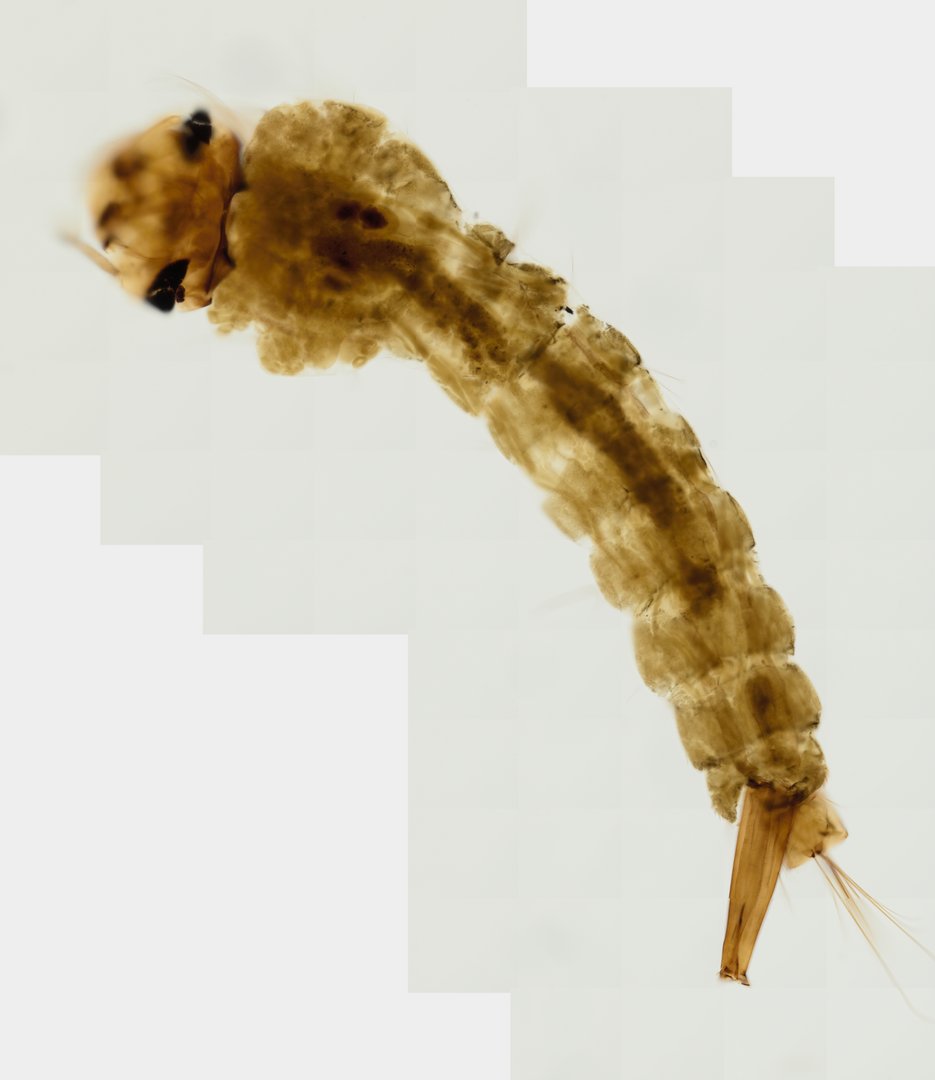
This is a whole mosquito larva mounted on a slide, unstained. Mosquito larvae live in water and breathe air through a tube at their tail end, which is why standing water matters for mosquito control.
A whole mount (W.M.) preparation of a mosquito larva (labeled Mosquito Larva W.M.). The specimen highlights the distinct head with prominent eye spots, a broad unsegmented thorax, an elongated segmented abdomen with lateral setal tufts, and a sclerotized breathing siphon extending from the posterior terminal segment.
What to look for
- Head: A rounded front section with dark eye spots and mouth brushes for feeding.
- Thorax: A broad section behind the head, wider than the rest of the body.
- Abdomen: A long, segmented section with tufts of hairs on the sides.
- Breathing siphon: A darker tube near the tail end used to breathe air at the water surface.
- Anal papillae: Small finger-like structures at the tip of the last segment.
At each magnification
Low power (about 4x)
The whole long body with a wide thorax and a tube near the tail.
Medium power (about 10x)
The body segments, hair tufts, and siphon.
High power (about 40x)
The mouth brushes, eye spots, and hairs on the siphon.
Questions and answers
What does a mosquito larva look like under a microscope?
A mosquito larva has a head with feeding brushes, a wide thorax, and a long segmented abdomen with tufts of hairs. Near the tail is a breathing tube, or siphon, that it pokes up through the water surface to get air.
How can you tell Culex and Anopheles larvae apart?
Culex larvae, like this one, have a long breathing siphon and hang at an angle from the water surface. Anopheles larvae have no siphon and lie flat just under the surface.
- Category
- Invertebrates
- Scan magnification
- 20x
- Stain
- Unstained
- Tags
- Mosquito larva w.m., Mosquito Larva W.M., Mosquito larva whole mount, Mosquito larva, Culex sp., Mosquito
Viewing this slide in class
This is a scan of a real prepared slide, not a simulation or a drawing. On StudyScope you can pan from the whole slide down to individual structures, always in focus, and measure them in real micrometers with the calibrated ruler. Present it live and every student screen follows your view and annotations. Students join with a room code on Chromebooks, iPads, or any browser, with no accounts.